One of the biggest frustrations I have as a parent is that my oldest son is a reluctant reader. He reads fine and does well in school, but he has zero interest in reading for pleasure outside of an assignment. When he is assigned books, he gets through them and rarely enjoys the process.
When assigned to read Hatchet by Gary Paulsen, that attitude changed. He came home from school and started talking about Hatchet. The spark was ignited! He told me it was a fantastic book, and he hated to have to wait until the next day to continue reading. He wanted to sit down and read it as fast as he could! He’d never felt that way about a book before!
Each day my son would come home from school and voluntarily, which is uncommon with a middle schooler, tell me all about the chapter he had read that day! Seeing this book spark so much excitement in him made me realize this was a novel study that I needed to create!
We earn a commission if you make a purchase, at no additional cost to you.
Hatchet by Gary Paulsen is a classic adventure novel that has been a staple in classrooms. It is a gripping story of survival and perseverance that teaches valuable life lessons to young readers. Hatchet is a perfect novel for students to study and should be a part of your curriculum.
Promotes Critical Thinking and Problem-Solving Skills:
Hatchet presents its young protagonist, Brian, with a series of challenges and obstacles that he must overcome in order to survive in the wilderness. These challenges require him to use his critical thinking and problem-solving skills, making the book an excellent tool for developing these skills in students. The book encourages students to think deeply about the characters’ choices and decisions and to consider alternative solutions to the problems they face.
Teaches Survival Skills:
Hatchet is centered around Brian’s survival in the wilderness, making it an excellent tool for teaching students about survival skills. From building shelter, to finding food and water, the book provides a hands-on learning experience for students. These lessons can help students understand the importance of self-sufficiency and resourcefulness in their own lives.
Develops Vocabulary and Reading Comprehension:
The language used in Hatchet is rich and descriptive, which makes it an excellent tool for developing vocabulary and reading comprehension. The book is also an excellent example of storytelling, and students can learn about the elements of plot, characterization, and setting as they read.
Fosters Empathy and Understanding:
Hatchet is a powerful story of perseverance and determination, and it encourages students to think about what it means to be a survivor. The book helps students understand the importance of perseverance and determination in their own lives and fosters empathy and understanding toward others who may be facing similar challenges.
Using Hatchet in the classroom is a great way to hook those reluctant readers and turn them on to reading!
Hatchet is a valuable novel to use in the classroom. It promotes critical thinking and problem-solving skills, teaches survival skills, develops vocabulary and reading comprehension, and fosters empathy and understanding. By incorporating Hatchet into your curriculum, you can help your students gain a deeper understanding of the world around them and develop valuable life skills that will serve them well into the future.
You can purchase this novel study which contains both a printable and a Google Drive™ format at the following locations:
Are you interested in reading about and sharing ideas with other educators on using children’s literature in your classroom? My goal is to bring together teachers and homeschoolers who teach grades 3-8 and use novels with their students. I’d love for you to join me to learn, share, and grow together!
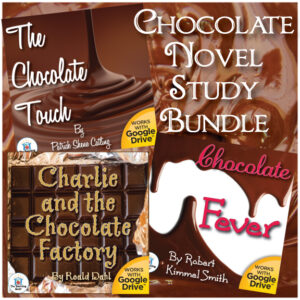
One of my favorite (and my students’) themes to explore every year was the Chocolate Theme. We would read The Chocolate Touch by Patrick Skene Catling:
We earn a commission if you make a purchase, at no additional cost to you.
Throughout the theme unit, we incorporated geography by mapping the different countries where the different ingredients of candy bars originate. We worked on letter writing by writing to different chocolate and candy companies with questions. This activity was particularly exciting because many of the companies would respond back to the students with offerings of trial samples or coupons to get free candy! Students learned the power they had as a consumer who shares feedback!
I always started the unit out with The Chocolate Touch written by Patrick Skene Catling which was first published in 1952. The story of loving chocolate never ages! John Midas loves chocolate and sweets more than anything and a wish turns his wildest dreams into a reality. Like King Midas before him, his touch is magic! This book leads to some great comparison activities with the King Midas story. Like King Midas, John soon learns that having too much of a great thing might not be as wonderful as he thought it would be!
I offer a complete novel study to accompany The Chocolate Touch for use in the classroom or homeschool. The unit includes both a printable format and a Google Drive™ format for use in a paperless classroom or with Google Classroom.
Try a free sample of the novel study for The Chocolate Touch
You can purchase this novel study at the following locations:
Chocolate Fever written by Richard Kimmel Smith in 1972, is a more humorous and adventurous tale of young Henry Green whose dream of eating nothing but chocolate comes true. Henry soon discovers that his new ability can be dangerous so he escapes and goes on the run!
I offer a complete novel study to accompany Chocolate Fever for use in the classroom or homeschool. The unit includes both a printable format and a Google Drive™ format for use in a paperless classroom or with Google Classroom.
Try a free sample of the novel study for Chocolate Fever
You can purchase this novel study at the following locations:
In my opinion, the best is saved for last, Roald Dahl’s 1964 classic, Charlie and the Chocolate Factory. This story has everything; a character to empathize with, several characters to learn from, humor, and imagination, it really has it all. Singing the Oompa Loompa songs together is always a fun time that ends in fits of giggles!
I offer a complete novel study to accompany Charlie and the Chocolate Factory for use in the classroom or homeschool. The unit includes both a printable format and a Google Drive™ format for use in a paperless classroom or with Google Classroom.
Try a free sample of the novel study for Charlie and the Chocolate Factory
You can purchase this novel study at the following locations:
Tying different areas of the curriculum together, and enjoying three wonderful novels together, the Chocolate Theme is a fun learning experience for all. It was truly one of the most favorite times I had with my students and it was something past students brought up as a favorite of their 4th-grade year with me. I encourage you to give it a try!
Are you interested in reading about and sharing ideas with other educators on using children’s literature in your classroom? My goal is to bring together teachers and homeschoolers who teach grades 3-8 and use novels with their students. I’d love for you to join me to learn, share, and grow together!
Here are a few of the most frequent questions that I am asked from buyers, and potential buyers, about my resources. Hopefully, you will find these answers helpful.
If you cannot find the answer to your question. Please email me directly.
If you still have questions, please email me directly.
Multiple-choice questioning is a popular form of assessment that has been widely used in educational settings for decades. While multiple-choice questions are easy to grade and score, they also have cons, making them suitable for some types of assessments and not for others.
Pros of Multiple Choice Questioning:
Ease of Grading: One of the biggest advantages of multiple-choice questions is that they are easy to grade and score. Since the options are pre-determined, the answer can be quickly checked against the correct response. This is especially useful in large classrooms where a teacher may not have enough time to grade each answer individually.
Objectivity: Multiple choice questions are considered to be more objective than other types of questions. This is because the answer is pre-determined, reducing the potential for subjective grading.
Versatility: Multiple choice questions can be used to assess a wide range of topics, making them suitable for many different types of assessments. Whether it is a science test or a history exam, multiple-choice questions can be tailored to suit the subject matter.
Time-Saving: Multiple choice questions can be completed relatively quickly, making them ideal for time-sensitive assessments. This is particularly useful for exams where time constraints are a factor.
Cons of Multiple Choice Questioning:
Limited Assessment Capabilities: Multiple-choice questions are limited in their ability to assess a student’s understanding of a subject. Since the answer is pre-determined, students are not able to elaborate on their thoughts or provide a more in-depth explanation of their knowledge.
Potential for Guesswork: Multiple-choice questions can encourage guesswork, especially when students are unsure of the answer. This can result in inaccurate results and a misleading representation of the student’s understanding of the material.
One-Dimensional: Multiple-choice questions are one-dimensional, meaning that they only assess one aspect of a student’s understanding of the material. This can result in a limited understanding of the student’s overall grasp of the subject.
Memorization vs. Understanding: Multiple-choice questions can also encourage memorization rather than true understanding of the material. This is because students may be able to correctly answer a question without truly understanding the concepts behind it.
I have a strong feeling about multiple-choice, more of a hate/love relationship. I feel it can encourage too much guessing and doesn’t give enough valid data on what a student has truly learned. I saw this in my classroom, usually with the students who struggle the most.
Students who were secure in their knowledge of the subject area will do fine, no matter the questioning format. I see this so much with my own son’s struggles in school. When given a multiple-choice test, more often than not, he’ll just make a guess, sometimes not even bothering to read the questions! In creating work for him, I always avoid using multiple choice, except in limited situations. When given a short answer question, he is much more apt to look for the answer using context or work the problem out for himself. If the option to guess is there, he’ll always choose it, and he’ll keep guessing until he’s eliminated the three wrong answers. Yes, he’ll eventually get the correct answer, but does that show he knew the content or was just successful at guessing?
I know multiple choice can be a huge time saver for the teacher. It is much quicker and easier to correct papers with multiple choice rather than written answers, but is it the right choice? What is our ultimate objective? To know the student understood and learned what we were teaching, right? How can we be sure that the objective was met with multiple-choice? Was the answer from retained knowledge or a lucky guess?
There are some cases (when done correctly) where I think M/C is fine. In a math problem for instance:
The problem on the left is wrong because the most common mistake a student will make in this instance is the misuse of PEDMA. The student will work the problem from left to right and end up with 6 for the answer. If this is one of the answer options, they will choose it and move on, not having any idea that they made a mistake. If they worked the problem in this manner, and 6 was not an option, they would know a mistake was made and go back to check their work. Of course, the guesser, who doesn’t even work out the problem, could guess in either case, but usually, a student will stop to take a closer look. I am not an advocate for tricking students. and in this example, that is exactly what is happening. It’s much less discouraging to a child to rework to find a correct answer than to get a test back that they failed due to being tricked!
One of the primary resources I offer is novel studies. In my novel studies, there are only two places where you will find multiple-choice options. First, the vocabulary quiz, where the sentence including the targeted word is given, along with four choices for students to choose the definition. Again, there are the guessers who will guess anything, but most students will be able to decipher the correct definition of the word used in context after the successful completion of the novel study activities.
The other multiple-choice option I offer is parts of a comprehension quiz. I try to balance multiple-choice and short-answer questions to best gauge students’ understanding of the novel and to address higher-order thinking questioning for rigor.
I only use short-answer questions in the daily comprehension portion of the novel study itself. I feel very strongly that while reading the book, the student should be thinking deeply about what they’re reading. Using multiple-choice for comprehension during the reading of the novel encourages the student to skim the text for the answer. It also means most of your questioning will be recall level, the lowest level of Bloom’s Taxonomy. I use novel studies to get away from the more superficial reading that students encounter with basal series activities. My goal in using novel studies is to get my student engaged in a novel, to think deeply about the character’s motives, make inferences, point of view, plot, foreshadowing, etc. I don’t believe this can be accomplished by using multiple-choice questions. I feel this adds rigor and integrity to my novel studies. I know there are some buyers who are disappointed in this stance, and I know that some buy from my competitors looking for something quick and easy, but it’s a core value that I feel very strongly about.
Multiple-choice questioning can be an effective method of assessment when used correctly and in the proper context. However, this style of questioning should not be relied upon as the sole method of assessment due to its limitations. To achieve a well-rounded understanding of a student’s knowledge and abilities, a combination of different types of questioning should be used, including open-ended questions and essay-style assessments.
Another reason I stay away from multiple-choice testing is it is far too similar to standardized testing, which I am not a fan! Mainly for all the reasons stated above. I want my students to be deep thinkers, not guessers. Of course, the whole topic of standardized testing is a post for another day! 😉
Beverly Cleary is a legend in children’s literature. Two of my favorite books are Dear Mr. Henshaw and the sequel, Strider, which take you on the journey of young Leigh Botts in his acceptance of his parent’s divorce and the road to acceptance of himself. They are great books to use in your classroom or homeschool for a whole class novel study, small book groups, or individual book studies.
We earn a commission if you make a purchase, at no additional cost to you.
Beverly Cleary has always strived to write books “about kids like us”. Her books are beloved because they are so relatable to her readers. Leigh struggles with his parent’s separation and his father’s absence due to his job as a truck driver. In Dear Mr. Henshaw Leigh connects with a favorite author and develops a pen pal relationship that helps him work through his feelings and anxieties.
From the Book Jacket for Dear Mr. Henshaw:
Beverly Cleary’s timeless Newbery Medal-winning book explores difficult topics like divorce, insecurity, and bullying through the thoughts and emotions of a sixth-grade boy as he writes to his favorite author, Boyd Henshaw.
After his parents separate, Leigh Botts moves to a new town with his mother. Struggling to make friends and deal with his anger toward his absent father, Leigh loses himself in a class assignment in which he must write to his favorite author. When Mr. Henshaw responds, the two form an unexpected friendship that will change Leigh’s life forever.
From the beloved author of the Henry Huggins, Ramona Quimby, and Ralph S. Mouse series comes an epistolary novel about how to navigate and heal from life’s growing pains.
Leigh’s story of growth and acceptance continues in Strider when he takes in a stray dog (Strider) that helps him accept his place in the world, introduces him to a love for running, and gives him hope for the future.
From the Book Jacket for Strider:
Strider has a new habit. Whenever we stop, he places his paw on my foot. It isn’t an accident because he always does it. I like to think he doesn’t want to leave me.
Can a stray dog change the life of a teenage boy? It looks as if Strider can. He’s a dog that loves to run; because of Strider, Leigh Botts finds himself running — well enough to join the school track team. Strider changes Leigh on the inside, too, as he finally begins to accept his parents’ divorce and gets to know a redheaded girl he’s been admiring. With Strider’s help, Leigh finds that the future he once hated to be asked about now holds something he never expected: hope.
Try a free sample of the novel study for Dear Mr. Henshaw
Beverly Cleary does a masterful job of showing Leigh’s growth through her portrayal of his letter writing and narration which makes a wonderful example for point of view instruction. Many kids can relate to Leigh’s feelings of loneliness, insecurity, sadness over a divorce, missing a parent, trying to find their way and/or talent, and having a beloved pet that gives them unconditional love. The universal relatability is what makes Dear Mr. Henshaw and Strider such wonderful novels to use in your classroom.
I offer complete novel studies to accompany Dear Mr. Henshaw and Strider for use in the classroom or homeschool. Each unit includes both a printable format and a Google Drive™ format for use in a paperless classroom or with Google Classroom.
You can purchase these novel studies at the following locations:
Or buy them bundled together at a 20% discount!
Are you interested in reading about and sharing ideas with other educators on using children’s literature in your classroom? My goal is to bring together teachers and homeschoolers who teach grades 3-8 and use novels with their students. I’d love for you to join me to learn, share, and grow together!