Some of my most vivid childhood memories of school were the novel studies I read for various subjects. It was my favorite way to learn skills, history, and any topic! I love books, and being allowed to read an entire book from cover to cover as a school assignment put me in heaven! I am sure this is a major reason why, as a teacher, my passion is to create and teach novel studies! I love introducing new books to my class, and as a community, being immersed in the book together. I love it when a student pulls us off the schedule with a question or comment from something they read and leads the class into a lively discussion. That’s where the real memorable learning takes place, after all!
I create novel studies more than any other product line simply because I like to focus on what I love. I want to work with my passion! I often get questions from readers asking how I would set up novel studies in my classroom. I decided to write a small series explaining my methods. For the most part, my novel studies include comprehension questions, vocabulary/grammar skill work, extension activities, and assessments.
Today’s post, part 2, deals with the vocabulary/grammar skill aspect of the novel studies. You can read part 1 here.
Novel Studies Part 2: Vocabulary/Grammar Skill Work
One of the beautiful things about reading books is that it expands your vocabulary. It introduces you to new words that you can build into your commentary. Being exposed to these new words within the context of a story helps the reader infer the meaning of the word, and it helps to see the word used in action to help the student understand its relevance.
When I create a novel study, I try and pick out all the words that would be unfamiliar to a reader while at the same time not overdoing it by having such a long list of words for each chapter that the reader is pulled from the story. Balance is imperative.
I would always write the vocabulary words for the day/chapter on the board before starting the reading so the student would keep a lookout for those words as they read.
I create a vocabulary bookmark for the student to have in hand as they read. They can record the page number of the word and note the inference they made about the meaning of the word as they encountered it in context. You can see how this is designed for my Harry Potter and the Chamber of Secrets Novel Study.
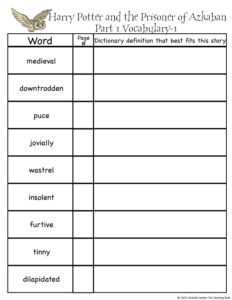
I also create another page that the student can attend to after they’ve completed their chapter reading. They will use their bookmark to locate the page number of the word. Next, they will look up the dictionary definition of the word and check it against the inference made on the bookmark as they read. You can see an example from my Harry Potter and the Prisoner of Azkaban Novel Study.
Each unit will contain some activities to work with the words and definitions, such as a crossword puzzle or word search.
I also like to work with grammar skills in context. My units contain a grammar skills activity for each vocabulary word that allows them to identify the part of speech of the word. There is also a sentence using the word written with improper grammar, missing punctuation, and misspellings. The student will need to correct the sentence to the proper written format. Here’s an example page from my Harry Potter and the Sorcerer’s Stone Novel Study.
All of my novel studies offer a Google Drive™ format, in addition to the printable format, shown above, to use with your students. This allows you to use novel studies in a 1:1 classroom, save paper, and easily engage students that are absent. Here’s an example page from the Google Drive™ format of my Harry Potter and the Half-Blood Prince Novel Study.
Pacing and approaching vocabulary in this manner has worked very well for me. It allows the students to think about the words and their meaning in context while not disrupting the story to learn the correct definitions.
Join me for part 3 of my series to learn the pacing methods I use for my novel studies.
Are you interested in reading about and sharing ideas with other educators on using children’s literature in your classroom? My goal is to bring together teachers and homeschoolers who teach grades 3-8 and use novels with their students. I’d love for you to join me to learn, share, and grow together!
Some of my most vivid childhood memories of school were the novel studies I read for various subjects. It was my favorite way to learn skills, history, and any topic! I love books, and being allowed to read an entire book from cover to cover as a school assignment put me in heaven! I am sure this is a major reason why, as a teacher, my passion is to create and teach novel studies! I love introducing new books to my class, and as a community, being immersed in the book together. I love it when a student pulls us off the schedule with a question or comment from something they read and leads the class into a lively discussion. That’s where the real memorable learning takes place, after all!
I create novel studies more than any other product line simply because I like to focus on what I love. I want to work with my passion! I often get questions from readers asking how I would set up novel studies in my classroom. I decided to write a small series explaining my methods. For the most part, my novel studies include comprehension questions, vocabulary/grammar skill work, extension activities, and assessments. Today’s post, part 1, deals with the comprehension aspect of the novel studies.
Novel Studies Part 1: Comprehension
One of the most compelling reasons to use whole novels in your reading instruction is to boost comprehension skills. A complete novel allows the student to delve deep into the characters’ minds and work through the plot from a detailed beginning to an end. You can’t achieve this level of deep understanding and thinking using short passages only. Students should be exposed to all methods of reading instruction, and complete novel studies fulfill a critical piece of the puzzle.
For students to dig deep into comprehension, they need the time to get lost in the narrative. Complete chapters will help them fall into the world of their book. The goal here is for students to think at the higher levels of the analysis and evaluation levels of Bloom’s Taxonomy.
To achieve this, I only use narrative questioning for my novel studies. The student needs to write out a complete statement in order to answer the question. Multiple-choice questions are not adequate to get the student to move beyond the lowest level of knowledge questioning of Bloom’s. You don’t want students doing quick guessing games to show what they’ve learned as they move through the book!
You can see that the questions will not allow the student to quick-skim the book. They can only answer if they’ve read, and the questions force them to think through what the character is thinking and put themselves into the character’s shoes. This type of questioning will take the student to the highest levels of both the cognitive and affective domains of Bloom’s Taxonomy.
You can also see that there are only five questions for the chapter. The questioning I use in my novel studies is usually only 1-6 questions per chapter. Students shouldn’t be inundated with questions in order to dig deep and show an understanding of what they’ve read. If the questioning is thorough, only a few questions are needed. I try to have at least one question per chapter, no matter how small it is. Of course, sometimes it is not necessary to assign a question just for the sake of assigning work if the chapter is too short.
Another reason for not overburdening the students with questions is to minimize the disruptions as they read. The more often they have to stop to answer questions, the less likely they are to get lost in the story. You want them to go all in!
All of my novel studies offer a Google Drive™ format, in addition to the printable format, shown above, to use with your students. This allows you to use novel studies in a 1:1 classroom, save paper, and easily engage students who are absent. Here’s an example page from the Google Drive™ format of my Esperanza Rising Novel Study.
Going through a story in this manner in regard to comprehension has worked very well for me. It forces those reluctant readers to put forth the effort to let themselves read deeply. The non-reluctant readers will be thrilled to be reading a complete book, so you’ve already hooked them!
Join me for part 2 in my series to learn the methods I use to try to turn my students into book detectives with vocabulary/grammar skill work using novel studies.
Are you interested in reading about and sharing ideas with other educators on using children’s literature in your classroom? My goal is to bring together teachers and homeschoolers who teach grades 3-8 and use novels with their students. I’d love for you to join me to learn, share, and grow together!
The reality of educational research is this: if you look hard enough, you can find support for almost any teaching strategy. Rarely is there a clear-cut answer about what works best. In most cases, effective teaching comes down to a teacher’s professional judgment, their students’ needs, and the flexibility they are given in the classroom.
Unfortunately, in today’s test-driven educational climate, teachers are often given less freedom than ever before. Rigid curriculum guidelines and scripted programs can make it difficult to adapt instruction, leaving little room for meaningful engagement or enrichment.
My Experience Using Novel Studies in the Classroom
I experienced this challenge firsthand while teaching 4th grade in a high-poverty, low-performing school. Many of my students entered my classroom reading at a 1st–2nd grade level, and very few were on grade level.
The biggest obstacle wasn’t just skill; it was motivation.
Our district relied heavily on a basal reading program that felt unrelatable and uninspiring to students. The stories lacked emotional connection, and students saw reading as a chore rather than something enjoyable or rewarding.
I knew something had to change.
How Read-Alouds Spark a Love of Reading
I started small by implementing a daily read-aloud time. My goal wasn’t rigorous analysis; I simply wanted students to enjoy a story.
This shift made a huge difference.
Upper elementary students are often overlooked when it comes to being read to, yet they benefit tremendously from it. By choosing high-interest, often humorous books, I was able to create a positive reading experience. Soon, read-aloud became one of the most anticipated parts of our day.
Why Novel Studies Work Better Than Basal Readers
Once I saw the impact of read-alouds, I began incorporating novel studies alongside our required curriculum.
Instead of limiting students to short excerpts, I introduced full novels connected to the themes in our basal program. The results were immediate and powerful:
Students reading below grade level began attempting more challenging texts
Engagement and participation increased dramatically
Discussions became deeper and more meaningful
Students started choosing to read independently
It became clear that reading an entire book provides a richer, more rewarding experience than isolated passages.
Improved Critical Thinking Through Deeper Reading
One of the biggest advantages of novel studies is the ability to promote higher-order thinking.
With a full-length text, students can:
Analyze character development
Explore complex themes
Make predictions and connections
Engage in meaningful discussions
Using Bloom’s Taxonomy becomes far more natural when students are immersed in a complete story rather than a short excerpt.
Building Real-World Connections and Empathy
Perhaps the most powerful benefit of novel studies is their ability to build empathy and awareness.
Through literature, students can explore real-world issues in a meaningful and age-appropriate way. For example:
These stories stay with students far longer than any worksheet ever could.
Do Novel Studies Improve Test Scores?
While I didn’t conduct formal research, I can confidently say this: My students’ test scores did not decline, and their love of reading increased significantly.
And that matters.
Because when students enjoy reading, they read more. And when they read more, their skills naturally improve.
Key Benefits of Using Novel Studies in the Classroom
Incorporating novel studies into your curriculum offers numerous advantages:
Improved Reading Skills: Students build comprehension, vocabulary, and fluency through sustained reading.
Increased Student Engagement: Novels capture interest and create emotional investment in learning.
Stronger Critical Thinking Skills: Students analyze, infer, and evaluate as they explore complex texts.
Enhanced Writing and Communication: Discussions and written responses deepen understanding and expression.
Greater Cultural Awareness: Literature exposes students to diverse perspectives and experiences.
Development of Empathy: Students connect with characters and better understand others’ experiences.
Encouragement of Independent Reading: Engaged students are more likely to read on their own.
Final Thoughts: Why Novel Studies Matter
Using novel studies in the classroom is one of the most effective ways to transform reading instruction.
While standardized programs may check boxes, novels create meaningful learning experiences. They engage students, deepen understanding, and foster a lifelong love of reading.
And ultimately, that’s what great teaching is all about.
Are you interested in reading about and sharing ideas with other educators on using children’s literature in your classroom? My goal is to bring together teachers and homeschoolers who teach grades 3-8 and use novels with their students. I’d love for you to join me to learn, share, and grow together!
Charlotte’s Web by E.B. White is one of those rare children’s books that can make students laugh, think deeply, and even shed a few tears—all while helping them develop important reading and ELA skills.
First published in 1952, this beloved classic continues to be a favorite for elementary classrooms. The friendship between Wilbur and Charlotte gives teachers an incredible opportunity to explore themes such as friendship, loyalty, kindness, empathy, courage, selflessness, and the cycle of life.
But Charlotte’s Web can be so much more than a book your students simply read.
With the right Charlotte’s Web novel study activities, this classic children’s novel can become the foundation for an engaging, meaningful ELA unit for grades 3-5.
We earn a commission if you make a purchase, at no additional cost to you.
Why Teach Charlotte’s Web in the Classroom?
There is a reason Charlotte’s Web has remained a classroom favorite for generations. The story is accessible and engaging for young readers, but it also provides plenty of opportunities for deeper thinking and discussion.
Students can connect with the characters, examine important themes, analyze the author’s choices, and consider the larger messages woven throughout the story.
Here are just a few of the reasons Charlotte’s Web works so well as a classroom novel.
1. Charlotte’s Web Teaches Empathy
One of the greatest strengths of Charlotte’s Web is its ability to encourage students to see the world from someone else’s perspective.
Wilbur experiences fear, loneliness, excitement, friendship, and loss. Charlotte demonstrates compassion and selflessness as she works to help her friend.
These experiences give teachers natural opportunities to ask questions such as:
How do the characters respond when someone needs help?
What does it mean to be a good friend?
How does Wilbur change throughout the story?
Why is Charlotte willing to sacrifice for Wilbur?
How do the characters demonstrate empathy?
These conversations can help students connect the events of the novel to their own lives and experiences.
2. Explore Friendship, Loyalty, and Kindness
At the heart of Charlotte’s Web is the friendship between Wilbur and Charlotte.
Their relationship provides countless opportunities for students to think about what makes a meaningful friendship.
Students can discuss:
What qualities make someone a good friend?
How do Wilbur and Charlotte help one another?
What does loyalty look like?
Why are acts of kindness important?
Can friendship require sacrifice?
These are questions that extend far beyond the novel and can lead to meaningful classroom conversations.
3. Develop Critical Thinking and Reading Comprehension Skills
Charlotte’s Web is also an excellent text for teaching reading comprehension and literary analysis.
Students can analyze characters, identify important story elements, examine themes, make predictions, draw conclusions, and support their ideas with evidence from the text.
Instead of simply asking students what happened in each chapter, teachers can use the novel to encourage students to think about why events happened and how those events affect the characters.
This makes Charlotte’s Web an especially useful choice for a novel study or literature unit.
4. Encourage a Love of Reading
Sometimes the best way to encourage children to become lifelong readers is to give them a book they genuinely want to read.
Charlotte’s Web is filled with memorable characters and an engaging story that can draw students into the world of Zuckerman’s farm.
Wilbur, Charlotte, Templeton, Fern, and the other characters provide plenty of opportunities for students to laugh, wonder, question, and become emotionally invested in the story.
A well-planned Charlotte’s Web unit can help students experience literature as something more than an assignment.
5. Teach Important Life Lessons Through Literature
Charlotte’s Web naturally opens the door to conversations about some of life’s biggest ideas.
Students can explore:
Friendship
Loyalty
Kindness
Compassion
Selflessness
Courage
Responsibility
Change
Loss
Life and death
These themes make Charlotte’s Web particularly valuable because students aren’t simply practicing reading skills—they are also thinking about the world around them.
Make Charlotte’s Web More Than a Read-Aloud
A common challenge with teaching a class novel is finding the time to create meaningful activities to accompany every chapter.
You may want to include:
Reading comprehension questions
Vocabulary activities
Writing prompts
Grammar practice
Character analysis
Story elements
Discussion questions
Assessments
Extension activities
But creating all of those materials yourself can take hours.
That’s why I created a complete Charlotte’s Web Novel Study designed to give teachers the resources they need to teach the book without spending hours preparing activities.
📚 Charlotte’s Web Novel Study for Grades 3-5
My Charlotte’s Web Novel Study is a comprehensive ELA unit created for 3rd, 4th, and 5th grade students.
It includes both printable and digital Google Drive formats, making it flexible enough for traditional classrooms, paperless classrooms, Google Classroom, homeschool settings, small groups, and independent work.
In other words, you don’t have to spend your planning time searching for separate Charlotte’s Web worksheets, comprehension questions, vocabulary activities, and assessments.
They’re already organized into one complete novel study.
Want to See What’s Included?
Download the free preview to take a closer look at the activities and see how this Charlotte’s Web unit can fit into your classroom.
You can purchase this novel study at the following locations:
Turn a Classic Novel Into a Complete ELA Learning Experience
Charlotte’s Web has endured for more than 70 years because its story continues to resonate with readers.
Wilbur and Charlotte’s friendship gives students a chance to explore meaningful themes while practicing essential reading comprehension, vocabulary, writing, grammar, and critical-thinking skills.
Whether you’re planning a Charlotte’s Web novel study for 3rd grade, 4th grade, or 5th grade, looking for Charlotte’s Web activities, or searching for a complete ELA unit to accompany the novel, this classic is an excellent choice.
And with a ready-to-use novel study, you can spend less time creating materials and more time helping your students connect with the story.
Allow your students to experience Charlotte’s Web not just as a book to read, but as a story that can teach them about friendship, kindness, empathy, courage, and what it means to care for someone else.
Connect with Fellow Educators!
Are you teaching Charlotte’s Web this school year?
Join our free community, Book Talk with The Teaching Bank, to share ideas, grab freebies, and connect with 3rd–8th grade teachers using novels in the classroom!
*The Teaching Bank participates in the Amazon Associate Program and earns a fee from qualifying purchases made on the Amazon.com site.
Looking for a fun, engaging novel to read with your elementary students? Sideways Stories from Wayside School by Louis Sachar is an excellent choice for a 3rd-, 4th-, or 5th-grade novel study.
With its short chapters, outrageous characters, unexpected situations, and laugh-out-loud humor, this classic chapter book has a way of getting even reluctant readers interested in what happens next. But beneath all the silliness are plenty of opportunities to teach reading comprehension, vocabulary, character analysis, story elements, critical thinking, and writing.
If you’re looking for a novel that will keep students laughing while giving you meaningful opportunities to teach ELA skills, Sideways Stories from Wayside School deserves a place in your classroom library.
What Is Sideways Stories from Wayside School About?
Written by Louis Sachar, Sideways Stories from Wayside School takes readers to the wonderfully strange Wayside School, a school that was accidentally built thirty stories high—with one classroom on each floor.
The students and teachers at Wayside are anything but ordinary.
Each chapter introduces another bizarre situation, unusual character, or completely unexpected twist. The short, episodic chapters make the book especially accessible for elementary readers and provide natural stopping points for classroom discussions, reading responses, and comprehension activities.
And because the stories are so unpredictable, students are constantly wondering what could possibly happen next.
We earn a commission if you make a purchase, at no additional cost to you.
5 Reasons to Teach Sideways Stories from Wayside School
1. It Gets Kids Excited About Reading
One of the biggest advantages of Sideways Stories from Wayside School is simply that kids have fun reading it.
The humor and absurd situations make the novel highly engaging, while the short chapters can feel much more manageable to students who may be intimidated by longer chapter books.
For reluctant readers, that can make a huge difference.
Instead of seeing reading as a chore, students become invested in the characters and curious about the next ridiculous thing that will happen at Wayside School.
2. The Short Chapters Are Perfect for a Novel Study
The structure of the book makes it easy to incorporate into a whole-class novel study, small-group reading, literature circle, or independent reading unit.
The short chapters give teachers natural opportunities to:
Stop and check for understanding
Ask comprehension questions
Make predictions
Discuss characters
Identify important details
Practice vocabulary
Make text-to-self and text-to-world connections
Write about what they have read
Because the chapters are relatively short, you can also adjust the pacing to meet the needs of your students.
3. It Builds Reading Comprehension Skills
Don’t let the humor fool you—there are plenty of opportunities for serious reading comprehension instruction.
As students read Sideways Stories from Wayside School, they can practice identifying important details, making inferences, summarizing, analyzing characters, determining themes, and supporting their thinking with evidence from the text.
The unusual events also provide excellent opportunities for students to think critically about what they are reading.
Ask questions such as:
Why did the character make that choice?
What evidence supports your thinking?
How would you have handled the situation?
What can we infer from what the character says or does?
Questions like these turn an entertaining chapter book into a meaningful ELA learning experience.
4. It Provides Great Opportunities for Vocabulary Instruction
The book also provides opportunities to develop students’ vocabulary in context.
Rather than simply memorizing a list of definitions, students can encounter unfamiliar words while reading and use the surrounding text to determine meaning.
A Sideways Stories from Wayside School novel study can incorporate vocabulary practice alongside reading comprehension, helping students strengthen both their word knowledge and their ability to use context clues.
5. It Creates a Shared Classroom Experience
Few things build classroom community like a book that makes everyone laugh.
Reading Sideways Stories from Wayside School together gives students a shared experience they can discuss, debate, and enjoy.
The unusual characters and ridiculous situations naturally lead to classroom conversations:
Which character is your favorite?
Which story was the funniest?
What would you do if you attended Wayside School?
Which situation would you least want to experience yourself?
Those conversations can turn a simple read-aloud into a memorable classroom experience while encouraging students to communicate their ideas and listen to the perspectives of their classmates.
Sideways Stories from Wayside School Is Great for Reluctant Readers
If you have students who aren’t naturally enthusiastic about reading, this is a book worth considering.
The short chapters, humor, fast-moving stories, and unpredictable plot can make reading feel less overwhelming. Students don’t have to wait through hundreds of pages to reach an exciting event—the book delivers something new and unexpected throughout.
That makes Sideways Stories from Wayside School a particularly useful choice for upper elementary reading instruction.
How to Use Sideways Stories from Wayside School in Your Classroom
There are several ways you can incorporate this novel into your ELA instruction.
Whole-Class Novel Study
Read the book together and pause throughout the novel for comprehension questions, vocabulary instruction, discussion, and written responses.
Small-Group Reading
Use the book with a small reading group while other students work independently or at literacy centers.
Literature Circles
Have students read and discuss the book with classmates while practicing comprehension and communication skills.
Independent Reading
Students can read the novel independently and complete reading responses, vocabulary activities, or comprehension assignments as they progress through the book.
Read-Aloud
The humor makes this book especially fun to read aloud. Even students who struggle with reading independently can participate in discussions and enjoy the story.
Turn the Book Into a Complete ELA Novel Study
While Sideways Stories from Wayside School is entertaining enough to read simply for fun, pairing it with a structured novel study allows you to get much more instructional value from the book.
A complete novel unit can help you teach:
Reading comprehension
Vocabulary
Character analysis
Story elements
Critical thinking
Reading responses
Writing
Literary analysis
Text connections
Assessment
And the best part?
You don’t have to create all of those materials yourself.
📚 Save Time With a Ready-to-Use Sideways Stories from Wayside School Novel Study
If you’re planning to teach Sideways Stories from Wayside School, my Sideways Stories from Wayside School Novel Study provides a complete, ready-to-use unit for 3rd–5th grade ELA.
The resource includes printable and digital materials, so you can choose what works best for your classroom.
You’ll get:
✔ Detailed lesson plans ✔ Reading comprehension questions ✔ Vocabulary activities ✔ Writing activities ✔ Story elements activities ✔ Extension activities ✔ Assessments ✔ Answer keys ✔ Standards alignment ✔ Printable PDF materials ✔ Google Drive™ resources
It’s designed to give you the instructional materials you need without spending hours creating worksheets, questions, assessments, and answer keys from scratch.
Download the FREE preview to take a closer look at the Sideways Stories from Wayside School novel study and see how it can fit into your ELA instruction.
Whether you use this book for the whole class, small group, or individual instruction, you will find your students laughing and truly enjoying reading. They are so much fun and really open up the reading world for those reluctant readers!
You can purchase this novel study at the following locations:
Whether you use it as a whole-class novel study, small-group reading unit, literature circle, or independent reading activity, Sideways Stories from Wayside School is a book that can make reading instruction more engaging—and a whole lot more fun.
Final Thoughts
The best classroom novels are the ones that students remember long after they’ve finished reading them.
Sideways Stories from Wayside School is funny, imaginative, unpredictable, and accessible, making it an excellent choice for elementary students and upper elementary ELA instruction.
More importantly, it gives teachers countless opportunities to combine engaging children’s literature with meaningful reading comprehension, vocabulary, writing, and critical-thinking instruction.
If you’re searching for a 3rd, 4th, or 5th grade novel study that will keep students engaged while helping you teach important ELA skills, give Sideways Stories from Wayside School a place in your reading plans.
Connect with Fellow Educators!
Are you teaching Sideways Stories From Wayside School this school year?
Join our free community, Book Talk with The Teaching Bank, to share ideas, grab freebies, and connect with 3rd–8th grade teachers using novels in the classroom!
*The Teaching Bank participates in the Amazon Associate Program and earns a fee from qualifying purchases made on the Amazon.com site.


 Novel Studies Part 2: Vocabulary/Grammar Skill Work
 When I create a novel study, I try and pick out all the words that would be unfamiliar to a reader while at the same time not overdoing it by having such a long list of words for each chapter that the reader is pulled from the story. Balance is imperative.
 I also like to work with grammar skills in context. My units contain a grammar skills activity for each vocabulary word that allows them to identify the part of speech of the word. There is also a sentence using the word written with improper grammar, missing punctuation, and misspellings. The student will need to correct the sentence to the proper written format. Here’s an example page from my Harry Potter and the Sorcerer’s Stone Novel Study.
 All of my novel studies offer a Google Drive™ format, in addition to the printable format, shown above, to use with your students. This allows you to use novel studies in a 1:1 classroom, save paper, and easily engage students that are absent. Here’s an example page from the Google Drive™ format of my Harry Potter and the Half-Blood Prince Novel Study.


 Novel Studies Part 1: Comprehension

 All of my novel studies offer a Google Drive™ format, in addition to the printable format, shown above, to use with your students. This allows you to use novel studies in a 1:1 classroom, save paper, and easily engage students who are absent. Here’s an example page from the Google Drive™ format of my






 Connect with Fellow Educators!