Some of my most vivid childhood memories of school were the novel studies I read for various subjects. It was my favorite way to learn skills, history, and any topic! I love books, and being allowed to read an entire book from cover to cover as a school assignment put me in heaven! I am sure this is a major reason why, as a teacher, my passion is to create and teach novel studies! I love introducing new books to my class, and as a community, being immersed in the book together. I love it when a student pulls us off the schedule with a question or comment from something they read and leads the class into a lively discussion. That’s where the real memorable learning takes place, after all!
I create novel studies more than any other product line simply because I like to focus on what I love. I want to work with my passion! I often get questions from readers asking how I would set up novel studies in my classroom. I decided to write a small series explaining my methods. For the most part, my novel studies include comprehension questions, vocabulary/grammar skill work, extension activities, and assessments.
Today’s post, part 3, deals with pacing the novel study. You can read part 1 and part 2 here.
Novel Studies Part 3: Pacing
One of the challenges of using novel studies in the classroom is finding the time. It’s a balance between not moving too fast and not letting the unit drag on for too long because we all know you have a million other things to squeeze into your curriculum!
Each of my complete novel studies includes detailed daily teacher lesson plans that include the objective and directions for the day. You can see how this is designed fo my Freak the Mighty Novel Study.
I also create a pacing guide for each novel study that helps you map out your long-range plan. You can see an example here from my Crenshaw Novel Study.
It’s a delicate balance to set the pacing. I generally try to aim for approximately 20 pages to read per day. This will be altered based on the chapter sizes. I don’t schedule split chapters as I feel this disrupts the reader. I know I hate to stop reading mid-chapter. That’s just mean!
All of my novel studies offer a Google Drive™ format, in addition to the printable format, shown above, to use with your students. This allows you to use novel studies in a 1:1 classroom, save paper, and easily engage students that are absent. Here’s an example page from the Google Drive™ format of my Wishtree Novel Study. The same pacing would apply for the Google™ version as you would use for the printable version.
This pacing is a suggestion as it has worked for me, but it is very adaptable, so you can work to fit it into the schedule that you are working with. The planning pages are written for a whole class novel study, but can be easily adapted to fit small book groups or individual novel studies. How much teacher interaction you want to have during the course of the study is up to you and can be worked in with the suggested pacing.
Join me for part 4 of my series to learn how I add extra experiences to my novel studies for deeper learning and growth.
Are you interested in reading about and sharing ideas with other educators on using children’s literature in your classroom? My goal is to bring together teachers and homeschoolers who teach grades 3-8 and use novels with their students. I’d love for you to join me to learn, share, and grow together!
Some of my most vivid childhood memories of school were the novel studies I read for various subjects. It was my favorite way to learn skills, history, and any topic! I love books, and being allowed to read an entire book from cover to cover as a school assignment put me in heaven! I am sure this is a major reason why, as a teacher, my passion is to create and teach novel studies! I love introducing new books to my class, and as a community, being immersed in the book together. I love it when a student pulls us off the schedule with a question or comment from something they read and leads the class into a lively discussion. That’s where the real memorable learning takes place, after all!
I create novel studies more than any other product line simply because I like to focus on what I love. I want to work with my passion! I often get questions from readers asking how I would set up novel studies in my classroom. I decided to write a small series explaining my methods. For the most part, my novel studies include comprehension questions, vocabulary/grammar skill work, extension activities, and assessments.
Today’s post, part 2, deals with the vocabulary/grammar skill aspect of the novel studies. You can read part 1 here.
Novel Studies Part 2: Vocabulary/Grammar Skill Work
One of the beautiful things about reading books is that it expands your vocabulary. It introduces you to new words that you can build into your commentary. Being exposed to these new words within the context of a story helps the reader infer the meaning of the word, and it helps to see the word used in action to help the student understand its relevance.
When I create a novel study, I try and pick out all the words that would be unfamiliar to a reader while at the same time not overdoing it by having such a long list of words for each chapter that the reader is pulled from the story. Balance is imperative.
I would always write the vocabulary words for the day/chapter on the board before starting the reading so the student would keep a lookout for those words as they read.
I create a vocabulary bookmark for the student to have in hand as they read. They can record the page number of the word and note the inference they made about the meaning of the word as they encountered it in context. You can see how this is designed for my Harry Potter and the Chamber of Secrets Novel Study.
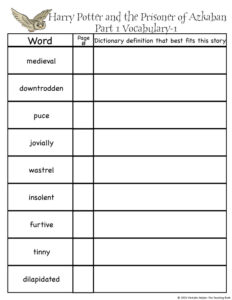
I also create another page that the student can attend to after they’ve completed their chapter reading. They will use their bookmark to locate the page number of the word. Next, they will look up the dictionary definition of the word and check it against the inference made on the bookmark as they read. You can see an example from my Harry Potter and the Prisoner of Azkaban Novel Study.
Each unit will contain some activities to work with the words and definitions, such as a crossword puzzle or word search.
I also like to work with grammar skills in context. My units contain a grammar skills activity for each vocabulary word that allows them to identify the part of speech of the word. There is also a sentence using the word written with improper grammar, missing punctuation, and misspellings. The student will need to correct the sentence to the proper written format. Here’s an example page from my Harry Potter and the Sorcerer’s Stone Novel Study.
All of my novel studies offer a Google Drive™ format, in addition to the printable format, shown above, to use with your students. This allows you to use novel studies in a 1:1 classroom, save paper, and easily engage students that are absent. Here’s an example page from the Google Drive™ format of my Harry Potter and the Half-Blood Prince Novel Study.
Pacing and approaching vocabulary in this manner has worked very well for me. It allows the students to think about the words and their meaning in context while not disrupting the story to learn the correct definitions.
Join me for part 3 of my series to learn the pacing methods I use for my novel studies.
Are you interested in reading about and sharing ideas with other educators on using children’s literature in your classroom? My goal is to bring together teachers and homeschoolers who teach grades 3-8 and use novels with their students. I’d love for you to join me to learn, share, and grow together!
Number the Stars by Lois Lowry is a powerful historical fiction novel that gives upper-elementary and middle-grade students an opportunity to explore courage, friendship, resistance, empathy, and standing up against injustice.
Set in Denmark during World War II, the novel follows Annemarie Johansen and her family as they help their Jewish friends escape the Nazi occupation. Through Annemarie’s eyes, students encounter a difficult period in history while experiencing a story that is accessible, engaging, and filled with opportunities for meaningful discussion.
If you’re planning a Number the Stars novel study for your 4th, 5th, or 6th grade students, this guide will give you ideas for connecting the novel to reading comprehension, vocabulary, critical thinking, history, and social-emotional learning.
We earn a commission if you make a purchase, at no additional cost to you.
Why Teach Number the Stars?
One of the greatest strengths of Number the Stars is that it allows students to encounter history through the experiences of a child.
Rather than simply reading facts about World War II, students follow Annemarie as she begins to understand what is happening around her. This creates natural opportunities to discuss questions such as:
What does it mean to be courageous?
Why do people sometimes have to make difficult choices?
How can ordinary people respond when others are being treated unfairly?
What makes someone a good friend?
How do fear and courage influence the decisions people make?
Why is it important to learn about difficult moments in history?
These questions can move students beyond simple recall and toward deeper reading comprehension and critical thinking.
Teaching Historical Fiction Through Number the Stars
Number the Stars works particularly well as a historical fiction novel because students can examine both the story and the historical context surrounding it.
As students read, encourage them to distinguish between what is happening in the fictional story and what they can learn about the real historical events that inspired it.
You can explore:
World War II
Nazi-occupied Denmark
The Danish Resistance
The rescue of Danish Jews
The Holocaust
Geography of Denmark and Sweden
Courage and resistance
Friendship and loyalty
Prejudice and discrimination
Human rights
This makes Number the Stars an excellent choice for connecting ELA and social studies.
Number the Stars Reading Comprehension
A novel study shouldn’t turn a great book into a stack of worksheets.
The goal is to help students think more deeply about what they’re reading while still allowing them to become immersed in the story.
When teaching Number the Stars, comprehension questions can focus on:
Character motivations
Making inferences
Cause and effect
Predicting
Making connections
Identifying themes
Using text evidence
Analyzing character development
Understanding historical context
I recommend using a small number of thoughtful questions rather than overwhelming students with questions after every few pages.
The questions should encourage students to explain why they think something happened—not simply identify what happened.
Vocabulary and Grammar in Context
Number the Stars also provides an excellent opportunity to teach vocabulary in context.
Instead of giving students a long list of unrelated vocabulary words, have them encounter words as they appear within the story.
Students can:
Determine meaning from context
Identify parts of speech
Use new words in sentences
Practice spelling
Explore synonyms and related words
Apply vocabulary through writing
This approach allows vocabulary instruction to become part of the reading experience rather than something completely separate from the novel.
The unit can be used with a whole class, small reading group, homeschool student, or independent reader. It includes both printable materials and digital resources for Google Drive.
What’s Included?
The complete Number the Stars Novel Study includes:
Teacher Resources
Detailed daily lesson plans
Pacing and Standards Guide
Chapter/Section Guide
Vocabulary Word Wall Cards
Answer Keys
Parent Letter
Student Resources
Spelling list
Vocabulary activities
Grammar activities
Chapter-by-chapter comprehension questions
Short-answer questions designed to encourage deeper thinking
Book-related extension activities
End-of-book activities
Story Elements Interactive Notebook activities
Assessment Resources
Part 1 assessment covering Chapters 1–6
Part 2 assessment covering Chapters 7–end
Vocabulary questions
Comprehension questions
Essay questions
Digital assessment options
The unit also includes Common Core Standards alignment for grades 4–6.
Print or Digital? You Get Both!
Today’s classrooms aren’t one-size-fits-all, so this novel study includes both printable and Google Drive-compatible formats.
Use the printable version for traditional instruction, or assign the digital activities through your classroom platform.
The digital format can be especially helpful for:
1:1 classrooms
Paperless classrooms
Students working from home
Absent students
Small-group instruction
Independent work
The assessments also include digital options, with multiple-choice Google Forms quizzes available for self-grading.
Save Time With a Ready-to-Teach Novel Unit
Teaching an entire novel is rewarding, but the planning can be time-consuming.
This Number the Stars novel unit was created to give you a complete framework so you don’t have to create every comprehension question, vocabulary activity, lesson plan, and assessment yourself.
It is designed to be low-prep and ready to teach, while still giving you flexibility to adjust the pacing and activities for your students.
You can purchase this novel study at the following locations:
💬 Connect with Fellow Educators!
Are you teaching Number the Stars this school year? How do you celebrate kindness in your classroom?
Join our free community, Book Talk with The Teaching Bank, to share ideas, grab freebies, and connect with 3rd–8th grade teachers using novels in the classroom!
*The Teaching Bank participates in the Amazon Associate Program and earns a fee from qualifying purchases made on the Amazon.com site.
Some of my most vivid childhood memories of school were the novel studies I read for various subjects. It was my favorite way to learn skills, history, and any topic! I love books, and being allowed to read an entire book from cover to cover as a school assignment put me in heaven! I am sure this is a major reason why, as a teacher, my passion is to create and teach novel studies! I love introducing new books to my class, and as a community, being immersed in the book together. I love it when a student pulls us off the schedule with a question or comment from something they read and leads the class into a lively discussion. That’s where the real memorable learning takes place, after all!
I create novel studies more than any other product line simply because I like to focus on what I love. I want to work with my passion! I often get questions from readers asking how I would set up novel studies in my classroom. I decided to write a small series explaining my methods. For the most part, my novel studies include comprehension questions, vocabulary/grammar skill work, extension activities, and assessments. Today’s post, part 1, deals with the comprehension aspect of the novel studies.
Novel Studies Part 1: Comprehension
One of the most compelling reasons to use whole novels in your reading instruction is to boost comprehension skills. A complete novel allows the student to delve deep into the characters’ minds and work through the plot from a detailed beginning to an end. You can’t achieve this level of deep understanding and thinking using short passages only. Students should be exposed to all methods of reading instruction, and complete novel studies fulfill a critical piece of the puzzle.
For students to dig deep into comprehension, they need the time to get lost in the narrative. Complete chapters will help them fall into the world of their book. The goal here is for students to think at the higher levels of the analysis and evaluation levels of Bloom’s Taxonomy.
To achieve this, I only use narrative questioning for my novel studies. The student needs to write out a complete statement in order to answer the question. Multiple-choice questions are not adequate to get the student to move beyond the lowest level of knowledge questioning of Bloom’s. You don’t want students doing quick guessing games to show what they’ve learned as they move through the book!
You can see that the questions will not allow the student to quick-skim the book. They can only answer if they’ve read, and the questions force them to think through what the character is thinking and put themselves into the character’s shoes. This type of questioning will take the student to the highest levels of both the cognitive and affective domains of Bloom’s Taxonomy.
You can also see that there are only five questions for the chapter. The questioning I use in my novel studies is usually only 1-6 questions per chapter. Students shouldn’t be inundated with questions in order to dig deep and show an understanding of what they’ve read. If the questioning is thorough, only a few questions are needed. I try to have at least one question per chapter, no matter how small it is. Of course, sometimes it is not necessary to assign a question just for the sake of assigning work if the chapter is too short.
Another reason for not overburdening the students with questions is to minimize the disruptions as they read. The more often they have to stop to answer questions, the less likely they are to get lost in the story. You want them to go all in!
All of my novel studies offer a Google Drive™ format, in addition to the printable format, shown above, to use with your students. This allows you to use novel studies in a 1:1 classroom, save paper, and easily engage students who are absent. Here’s an example page from the Google Drive™ format of my Esperanza Rising Novel Study.
Going through a story in this manner in regard to comprehension has worked very well for me. It forces those reluctant readers to put forth the effort to let themselves read deeply. The non-reluctant readers will be thrilled to be reading a complete book, so you’ve already hooked them!
Join me for part 2 in my series to learn the methods I use to try to turn my students into book detectives with vocabulary/grammar skill work using novel studies.
Are you interested in reading about and sharing ideas with other educators on using children’s literature in your classroom? My goal is to bring together teachers and homeschoolers who teach grades 3-8 and use novels with their students. I’d love for you to join me to learn, share, and grow together!
If you’re looking for a funny, engaging novel to read with your elementary students, Wayside School Beneath the Cloud of Doom by Louis Sachar is a fantastic choice.
After more than forty years, Louis Sachar returned to the wonderfully wacky world of Wayside School—and this newest adventure delivers the same absurd humor, unexpected situations, and laugh-out-loud moments that have made the Wayside School books classroom favorites for generations.
For teachers who love using children’s literature and novel studies to build reading skills, Wayside School Beneath the Cloud of Doom offers plenty of opportunities for reading comprehension, vocabulary development, critical thinking, creativity, discussion, and writing.
And if you’re looking for a Wayside School Beneath the Cloud of Doom novel study to make teaching the book easier, I’ve created a complete, no-prep unit to accompany the novel.
We earn a commission if you make a purchase, at no additional cost to you.
📚 Why Teach Wayside School Beneath the Cloud of Doom?
One of the best things about Louis Sachar’s Wayside School books is how quickly they capture students’ attention.
The world of Wayside School is anything but ordinary. Strange things happen. Characters behave in unexpected ways. Problems don’t always have predictable solutions. And just when students think they understand what’s happening, the story can take another hilarious turn.
That makes Wayside School Beneath the Cloud of Doom an excellent book for getting students excited about reading while also developing important ELA skills.
Here are some of the ways this novel can support learning in your classroom.
😂 1. Encourage a Love of Reading
Let’s face it: getting students excited about reading matters.
When students genuinely enjoy a book, they’re more likely to want to keep reading, participate in discussions, and explore other books.
Wayside School Beneath the Cloud of Doom is filled with humor, unusual characters, and unexpected situations that can keep reluctant readers engaged.
The humor also makes the book especially enjoyable as a class read-aloud.
If you’ve ever read a Wayside School book aloud to a class, you probably already know what happens next: students start laughing, anticipating what might happen, and sharing their reactions with one another.
Those moments can help create something every teacher wants—a classroom community built around books and reading.
💡 2. Spark Creativity and Imagination
The world of Wayside School is wonderfully unpredictable.
Students encounter situations that encourage them to think beyond the ordinary and imagine possibilities that don’t always follow the rules of the real world.
That makes this novel a natural starting point for creative writing and imaginative activities.
After reading, students can:
Create their own unusual Wayside School classroom
Invent a new character
Write a silly story set at Wayside School
Design an unexpected solution to a problem
Predict what might happen next
Compare their ideas with those of their classmates
These types of activities allow students to practice writing and communication skills without making writing feel like a chore.
🧠 3. Build Critical Thinking Skills
Funny doesn’t mean simple.
Wayside School Beneath the Cloud of Doom provides plenty of opportunities for students to think critically about characters, events, problems, and solutions.
As students read, encourage them to make predictions, look for clues, analyze characters, and explain their thinking.
You can ask questions such as:
What do you think will happen next?
Why did the character make that choice?
What clues helped you make that prediction?
How would you have handled the situation?
What makes this situation unusual?
What can we learn from the characters’ actions?
These discussions turn an entertaining story into a valuable reading comprehension and critical-thinking experience.
📖 4. Strengthen Reading Comprehension
A high-interest novel is an excellent vehicle for teaching comprehension skills.
With Wayside School Beneath the Cloud of Doom, students can practice:
Making inferences
Citing evidence from the text
Summarizing
Making predictions
Analyzing characters
Understanding cause and effect
Identifying important details
Making connections
Explaining their thinking
Instead of teaching these skills in isolation, you can teach and practice them using a story students actually want to read.
✏️ 5. Expand Vocabulary and Language Skills
Louis Sachar’s writing also provides opportunities to explore vocabulary and language.
A novel study can help students encounter unfamiliar words in context and practice determining meaning using clues from the surrounding text.
You can also use the novel as a springboard for:
Vocabulary activities
Context-clue practice
Word discussions
Character descriptions
Writing activities
Sentence development
Literary discussions
This allows vocabulary instruction to become part of the reading experience rather than a separate worksheet students complete without context.
🤝 6. Encourage Discussion and Collaboration
A great novel gives students something to talk about.
The unusual situations in Wayside School Beneath the Cloud of Doom make it particularly well suited for partner discussions, small-group conversations, literature circles, and whole-class discussions.
Students can compare their predictions, debate character choices, discuss solutions to problems, and share their reactions to the story.
These conversations give students practice with important communication skills while helping them learn from one another.
❤️ 7. Create Opportunities for Social-Emotional Learning
Although humor is one of the biggest draws of the Wayside School books, the characters and situations can also open the door to meaningful conversations.
Teachers can use the novel to discuss topics such as:
Friendship
Empathy
Problem-solving
Resilience
Cooperation
Communication
Understanding different perspectives
The humor creates an approachable way for students to discuss how characters respond to challenges and interact with one another.
📚 A Complete Wayside School Beneath the Cloud of Doom Novel Study
Want to teach Wayside School Beneath the Cloud of Doom without spending hours creating comprehension questions, vocabulary activities, assessments, and lesson plans?
The no-prep novel study includes both printable and digital resources, so you can use it in a traditional classroom, paperless classroom, Google Classroom, small group, or homeschool setting.
What’s Included?
The Wayside School novel study includes:
Daily lesson plans
Pacing and standards guide
Vocabulary activities
Vocabulary Word Wall Cards
Chapter-by-chapter comprehension questions
Reading comprehension activities
Book-specific extension activities
Spelling list
End-of-book assessment
Vocabulary assessment
Essay question
Digital Google Drive™ assessment
End-of-the-book activity packet
Story Elements Interactive Notebook Activity Packet
Complete answer keys
Common Core Standards alignment for grades 3-5
The resource includes 130+ PDF pages, giving you a complete set of materials for your novel unit.
🖨️ Printable + Digital Formats
You don’t have to choose between paper and digital.
This Wayside School Beneath the Cloud of Doom book study includes both a printable PDF version and a Google Drive™ version.
Use the printable activities for traditional instruction or use the digital resources for a paperless novel study or Google Classroom.
Not sure if this Wayside School Beneath the Cloud of Doom novel study is right for your students?
Download the free preview and take a look at the included activities before you purchase.
It’s an easy way to see exactly what you’ll receive.
⭐ Make Your Wayside School Novel Unit Easier
Wayside School Beneath the Cloud of Doom is the kind of book that can make students laugh, think, discuss, and want to keep reading.
Whether you’re using it as a whole-class read-aloud, literature circle book, small-group novel, or independent reading selection, this Louis Sachar classic can provide a wonderful foundation for meaningful ELA instruction.
And with a ready-to-use Wayside School novel study, you don’t have to spend your evenings creating materials to go along with it.
Save your planning time and spend more time enjoying the book with your students.
👉 Get the Wayside School Beneath the Cloud of Doom Novel Study here.
More Wayside School Resources
If your students love Wayside School Beneath the Cloud of Doom, you can also explore the other books in the Wayside School series and use the Wayside School novel studies to create an engaging series-based reading experience.
💬 Connect with Fellow Educators!
Are you teaching Wayside School this school year? How do you celebrate kindness in your classroom?
Join our free community, Book Talk with The Teaching Bank, to share ideas, grab freebies, and connect with 3rd–8th grade teachers using novels in the classroom!
*The Teaching Bank participates in the Amazon Associate Program and earns a fee from qualifying purchases made on the Amazon.com site.


 Novel Studies Part 3: Pacing


 All of my novel studies offer a Google Drive™ format, in addition to the printable format, shown above, to use with your students. This allows you to use novel studies in a 1:1 classroom, save paper, and easily engage students that are absent. Here’s an example page from the Google Drive™ format of my Wishtree Novel Study. The same pacing would apply for the Google™ version as you would use for the printable version.


 Novel Studies Part 2: Vocabulary/Grammar Skill Work
 When I create a novel study, I try and pick out all the words that would be unfamiliar to a reader while at the same time not overdoing it by having such a long list of words for each chapter that the reader is pulled from the story. Balance is imperative.

 I also like to work with grammar skills in context. My units contain a grammar skills activity for each vocabulary word that allows them to identify the part of speech of the word. There is also a sentence using the word written with improper grammar, missing punctuation, and misspellings. The student will need to correct the sentence to the proper written format. Here’s an example page from my
 All of my novel studies offer a Google Drive™ format, in addition to the printable format, shown above, to use with your students. This allows you to use novel studies in a 1:1 classroom, save paper, and easily engage students that are absent. Here’s an example page from the Google Drive™ format of my





 Novel Studies Part 1: Comprehension


 All of my novel studies offer a Google Drive™ format, in addition to the printable format, shown above, to use with your students. This allows you to use novel studies in a 1:1 classroom, save paper, and easily engage students who are absent. Here’s an example page from the Google Drive™ format of my


