Stargirl by Jerry Spinelli is a popular young adult novel that has been widely praised for its insightful commentary on the struggles of adolescence, the importance of individuality, and the power of kindness.
We earn a commission if you make a purchase, at no additional cost to you.
If you’re looking for an engaging and thought-provoking book to add to your curriculum, here are a few reasons why you should consider Stargirl:
Is a Relevant and Relatable Story: Stargirl tells the story of a quirky and unconventional teenager named Susan “Stargirl” Caraway, who enters an Arizona high school and turns the social hierarchy on its head. Her unique personality, strange habits, and unapologetic individuality make her an outcast at first, but also attracts a small group of admirers who are drawn to her authenticity and kindness. The novel explores themes of conformity, popularity, and social pressure, which are all relevant and relatable issues for teenagers today.
Promotes Empathy and Acceptance: One of the main messages of Stargirl is the importance of accepting others for who they are, rather than trying to mold them into our own image of what is “normal” or “popular.” Stargirl’s refusal to conform to social norms challenges her classmates to question their own biases and prejudices and to see the value in people who are different from themselves. The novel encourages empathy and compassion and teaches readers that kindness and understanding are powerful tools for creating a more inclusive and welcoming community.
Is a Well-Written and Engaging Story: Jerry Spinelli is a master storyteller, and Stargirl is a well-written and engaging novel that will capture the attention of your students from the very first page. The characters are complex and multi-dimensional, the dialogue is authentic and witty, and the plot is both surprising and thought-provoking. The novel is also a relatively quick read, which makes it ideal for classroom use.
Sparks Discussion and Critical Thinking: Stargirl is a novel that will spark discussion and critical thinking in your classroom. The novel raises important questions about identity, conformity, individuality, and the nature of popularity. It challenges readers to think about their own beliefs and values and to consider how they can be more accepting and inclusive of others. The novel also provides opportunities for students to analyze character development, plot structure, and symbolism, and to develop their writing and critical thinking skills.
Standards-Aligned Text: Stargirl is a standard-aligned text that can be used to meet a variety of ELA standards. The novel covers a range of literary elements, including characterization, plot development, symbolism, and theme. It also provides opportunities for students to develop their reading comprehension, writing, and analysis skills. By using Stargirl in your classroom, you can ensure that your students are meeting the standards while also enjoying a rich and engaging literary experience.
Stargirl by Jerry Spinelli is a must-read for any classroom. Its relatable story, powerful themes, engaging characters, and critical thinking opportunities make it an ideal choice for teachers looking to inspire empathy, acceptance, and individuality in their students. By using this novel in your classroom, you can help your students develop their reading, writing, and critical thinking skills, while also fostering a more inclusive and compassionate classroom community.
I offer a complete novel study to accompany Stargirl for use in the classroom or homeschool. The unit includes both a printable format and a Google Drive™ format for use in a paperless classroom or with Google Classroom.
You can purchase this novel study at the following locations:
Are you interested in reading about and sharing ideas with other educators on using children’s literature in your classroom? My goal is to bring together teachers and homeschoolers who teach grades 3-8 and use novels with their students. I’d love for you to join me to learn, share, and grow together!
Incorporating powerful literature into the classroom is essential for fostering empathy, understanding, and critical thinking in students. One such novel is Prisoner B-3087 by Alan Gratz. This is one of the most impactful Holocaust books I have read. This gripping story, based on the true experiences of Holocaust survivor Jack Gruener, a young Jewish boy from Poland, provides a poignant glimpse into one of history’s darkest periods.
Watch a video of Alan Gratz speaking with the real Jack (Yanek) Gruener HERE!
We earn a commission if you make a purchase, at no additional cost to you.
Educators must foster empathy, promote global awareness, and instill a deep understanding of history, even the darkest parts so that we don’t repeat it! Alan Gratz meets these needs with Prisoner B-3087.
Benefits of Using Prisoner B-3087 in Your Classroom
Enhances Historical Understanding:Prisoner B-3087 immerses students in the harrowing experiences of a young boy enduring the Holocaust. By following Yanek’s journey through ten different concentration camps, students gain a deeper understanding of the historical events of World War II. This firsthand narrative helps humanize the statistics and facts often found in textbooks, making history more relatable and impactful.
Promotes Empathy and Compassion: Reading about Yanek’s struggles and perseverance fosters empathy and compassion in students. Understanding the hardships faced by individuals during the Holocaust encourages students to reflect on their own values and attitudes. This emotional connection to the characters and their experiences can lead to meaningful discussions about tolerance, diversity, and human rights.
Sparks Critical Thinking and Discussion:Prisoner B-3087 challenges students to think critically about moral and ethical dilemmas. By analyzing the characters’ decisions and the consequences of those actions, students develop their critical thinking and reasoning skills. Teachers can facilitate discussions and assignments that encourage students to explore complex questions, fostering a deeper intellectual engagement with the material.
Encourages Resilience and Perseverance: Yanek’s story is one of incredible resilience and perseverance. Despite unimaginable odds, he continues to fight for survival. This theme of resilience can inspire students to face their own challenges with determination and strength. Teachers can use Yanek’s journey as a starting point for discussions on overcoming adversity and the importance of hope and perseverance.
Integrates Multidisciplinary Learning: Prisoner B-3087 offers opportunities for interdisciplinary learning. Teachers can integrate lessons from history, literature, and social studies, creating a comprehensive educational experience. Additionally, art and writing projects inspired by the novel can enhance students’ creative expression and understanding of the material.
Supports Standards: The novel aligns with several standards, making it a valuable addition to the curriculum. It supports standards in reading comprehension, critical analysis, and historical context. By incorporating Prisoner B-3087, teachers can ensure they are meeting educational benchmarks while providing an engaging and meaningful learning experience.
Incorporating Prisoner B-3087 by Alan Gratz into the classroom offers numerous benefits. From enhancing historical understanding to promoting empathy and critical thinking, this novel provides a rich, multidimensional learning experience. By engaging with Yanek’s story, students can develop a deeper appreciation for history, compassion for others, and resilience in their own lives. Integrate Prisoner B-3087 into your curriculum to create a powerful and transformative educational experience for your students.
I offer a complete novel study to accompany Prisoner B-3087, for use in the classroom or homeschool. The unit includes both a printable format and a Google Drive™ format for use in a paperless classroom or with Google Classroom. The novel study includes non-fiction reading passages covering:
”Life in Kraków, Poland 1939-1942”
”Life in the Plaszów Concentration Camp 1942-1943”
”Amon Goeth”
”The Wieliczka Salt Mine 1943-1944”
”Life in Trzebinia Concentration Camp 1944”
”Life in Birkenau Concentration Camp 1944-1945”
”Life in the Auschwitz Concentration Camp 1945”
”Death Marches of 1945”
”Life in Sachsenhausen Concentration Camp 1945”
”Life in Bergen-Belsen Concentration Camp 1945”
”Life in Buchenwald Concentration Camp 1945”
”Life in Gross-Rosen Concentration Camp 1945”
”Death March from Gross-Rosen in 1945”
”Life in Dachau Concentration Camp 1945”
”Life in Post-war Munich, Germany 1945”
”The Orphaned Jewish Visa Program”
”Oskar Schindler Schindler’s List”
Try a free sample of the novel study for Prisoner B-3087
You can purchase this novel study at the following locations:
Are you interested in reading about and sharing ideas with other educators on using children’s literature in your classroom? My goal is to bring together teachers and homeschoolers who teach grades 3-8 and use novels with their students. I’d love for you to join me to learn, share, and grow together!
The Chronicles of Narnia series, written by C.S. Lewis, is a classic in the world of literature. The series has been widely acclaimed for its vivid imagery, unique characters, and compelling storyline. The Voyage of the Dawn Treader, which is the fifth book in the series, is no exception.
We earn a commission if you make a purchase, at no additional cost to you.
Benefits of Using The Voyage of the Dawn Treader in Your Classroom:
Enhances creativity and imagination:The Voyage of the Dawn Treader takes readers on an unforgettable journey to the magical land of Narnia. The vivid descriptions of the world and the characters allow students to use their imagination and creativity to visualize the world in their own unique way. This can help foster a love of reading and creativity in students, which can be valuable skills for future success.
Develops critical thinking and analysis skills:The Voyage of the Dawn Treader is full of complex themes and ideas that require critical thinking and analysis to fully understand. By discussing these themes in the classroom, students can develop their analytical skills and learn how to think critically about the world around them. This can be especially useful for developing problem-solving skills and decision-making abilities.
Provides a unique perspective on moral and ethical issues: One of the core themes of The Voyage of the Dawn Treader is the idea of moral and ethical behavior. The characters in the novel are faced with difficult choices and moral dilemmas, which can provide a unique perspective on these issues for students. By discussing these themes in the classroom, students can learn how to make ethical decisions and understand the consequences of their actions.
Encourages empathy and understanding: The characters in The Voyage of the Dawn Treader come from diverse backgrounds and have different experiences. By reading about these characters, students can develop empathy and understanding for people who are different from themselves. This can help foster a sense of community and inclusivity in the classroom, which can be beneficial for all students.
Provides a gateway to other literary works:The Voyage of the Dawn Treader is just one book in a larger series of novels. By introducing students to this novel, teachers can encourage students to read other books in the series or other literary works by C.S. Lewis. This can help develop a love of reading and literature in students, which can have a positive impact on their academic and personal lives.
The Voyage of the Dawn Treader is an excellent novel to use in the classroom. It provides a unique perspective on moral and ethical issues, encourages creativity and imagination, and helps develop critical thinking and analysis skills. By using this novel in the classroom, teachers can help foster a love of reading and literature in their students and provide valuable skills for future success.
I offer a complete novel study to accompany The Voyage of the Dawn Treader for use in the classroom or homeschool. The unit includes both a printable format and a Google Drive™ format for use in a paperless classroom or with Google Classroom.
Are you interested in reading about and sharing ideas with other educators on using children’s literature in your classroom? My goal is to bring together teachers and homeschoolers who teach grades 3-8 and use novels with their students. I’d love for you to join me to learn, share, and grow together!
Some of my most vivid childhood memories of school were the novel studies I read for various subjects. It was my favorite way to learn skills, history, and any topic! I love books, and being allowed to read an entire book from cover to cover as a school assignment put me in heaven! I am sure this is a major reason why, as a teacher, my passion is to create and teach novel studies! I love introducing new books to my class, and as a community, being immersed in the book together. I love it when a student pulls us off the schedule with a question or comment from something they read and leads the class into a lively discussion. That’s where the real memorable learning takes place, after all!
I create novel studies more than any other product line simply because I like to focus on what I love. I want to work with my passion! I often get questions from readers asking how I would set up novel studies in my classroom. I decided to write a small series explaining my methods. For the most part, my novel studies include comprehension questions, vocabulary/grammar skill work, extension activities, and assessments.
Today’s post, part 2, deals with the vocabulary/grammar skill aspect of the novel studies. You can read part 1 here.
Novel Studies Part 2: Vocabulary/Grammar Skill Work
One of the beautiful things about reading books is that it expands your vocabulary. It introduces you to new words that you can build into your commentary. Being exposed to these new words within the context of a story helps the reader infer the meaning of the word, and it helps to see the word used in action to help the student understand its relevance.
When I create a novel study, I try and pick out all the words that would be unfamiliar to a reader while at the same time not overdoing it by having such a long list of words for each chapter that the reader is pulled from the story. Balance is imperative.
I would always write the vocabulary words for the day/chapter on the board before starting the reading so the student would keep a lookout for those words as they read.
I create a vocabulary bookmark for the student to have in hand as they read. They can record the page number of the word and note the inference they made about the meaning of the word as they encountered it in context. You can see how this is designed for my Harry Potter and the Chamber of Secrets Novel Study.
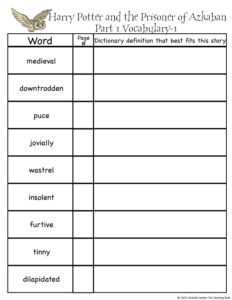
I also create another page that the student can attend to after they’ve completed their chapter reading. They will use their bookmark to locate the page number of the word. Next, they will look up the dictionary definition of the word and check it against the inference made on the bookmark as they read. You can see an example from my Harry Potter and the Prisoner of Azkaban Novel Study.
Each unit will contain some activities to work with the words and definitions, such as a crossword puzzle or word search.
I also like to work with grammar skills in context. My units contain a grammar skills activity for each vocabulary word that allows them to identify the part of speech of the word. There is also a sentence using the word written with improper grammar, missing punctuation, and misspellings. The student will need to correct the sentence to the proper written format. Here’s an example page from my Harry Potter and the Sorcerer’s Stone Novel Study.
All of my novel studies offer a Google Drive™ format, in addition to the printable format, shown above, to use with your students. This allows you to use novel studies in a 1:1 classroom, save paper, and easily engage students that are absent. Here’s an example page from the Google Drive™ format of my Harry Potter and the Half-Blood Prince Novel Study.
Pacing and approaching vocabulary in this manner has worked very well for me. It allows the students to think about the words and their meaning in context while not disrupting the story to learn the correct definitions.
Join me for part 3 of my series to learn the pacing methods I use for my novel studies.
Are you interested in reading about and sharing ideas with other educators on using children’s literature in your classroom? My goal is to bring together teachers and homeschoolers who teach grades 3-8 and use novels with their students. I’d love for you to join me to learn, share, and grow together!
“Everybody is a genius. But if you judge a fish by its ability to climb a tree, it will live its whole life believing that it is stupid.”
This a great quote that is often mistakingly attributed to Albert Einstein. He didn’t say this, but the quote is powerful, just the same.
This quote is the premise of the book Fish in a Treeby Lynda Mullaly Hunt. The main character is Ally, a sixth grader who hates school because she feels stupid and thinks she will never be successful. Ally has isolated herself and does not take any risks toward academic work or making friends. She feels everything is hopeless until a new teacher, Mr. Daniels, joins her class as a long-term substitute. Mr. Daniels recognizes Ally’s talents as an artist and is impressed by her “out of the box” problem-solving skills. He leads Ally to admit her fears and helps her to take risks that lead to a diagnosis of dyslexia. Mr. Daniels helps Ally build confidence and realize she’s not stupid, she just learns differently, which opens up the world academically and socially for Ally.
We earn a commission if you make a purchase, at no additional cost to you.
Fish in a Tree is a very inspirational book for all students, not just those with dyslexia. It showcases through the many different characters that everyone has talent and value, but sometimes it takes a little more work to discover! Research shows that 80-90% of all students identified as learning disabled have some degree of dyslexia. It is hypothesized that about 20% of the population is afflicted with dyslexia to some degree.
Fish in a Tree by Lynda Mullaly Hunt is a compelling novel that holds the potential to transform the classroom experience for both teachers and students alike.
Explore the numerous benefits of incorporating Fish in a Tree into your classroom:
Promotes Empathy and Understanding: Fish in a Tree delves into the life of Ally Nickerson, a brilliant young girl who struggles with dyslexia, a learning disability that challenges her academic journey. The story beautifully captures Ally’s emotions, challenges, and triumphs, allowing students to connect with her on a personal level. By immersing themselves in Ally’s world, students gain a deeper understanding of the experiences of their peers with learning differences, fostering empathy and compassion in the classroom.
Cultivates a Growth Mindset: The novel’s central theme revolves around the concept of a growth mindset. Ally initially believes she is unintelligent and unworthy due to her difficulties with reading. As the story unfolds, she discovers her strengths and begins to embrace her learning differences as a part of who she is. By following Ally’s transformation, students can grasp the importance of perseverance, determination, and embracing challenges. This growth mindset can inspire students to overcome their own obstacles and cultivate a positive attitude toward learning.
Enhances Language and Literacy Skills: Fish in a Tree is a captivating literary work that captures students’ attention with its engaging narrative and relatable characters. Utilizing this novel in the classroom provides an excellent opportunity to enhance language and literacy skills. Teachers can encourage active reading by facilitating discussions, journaling, and group activities centered around the novel’s themes, vocabulary, and writing techniques. Such activities not only improve comprehension but also encourage critical thinking and communication skills.
Encourages Diversity and Inclusivity: Lynda Mullaly Hunt artfully weaves a diverse set of characters throughout the story, each with their unique backgrounds and experiences. By exposing students to characters from diverse racial, socioeconomic, and family backgrounds, the novel fosters inclusivity and appreciation for individual differences. This exposure promotes a richer understanding of the world and encourages students to embrace diversity, both in the classroom and beyond.
Facilitates Cross-Curricular Learning: Fish in a Tree opens doors to cross-curricular learning opportunities. Teachers can integrate the novel into various subjects, such as history, science, and social studies, to explore relevant themes and historical contexts. For instance, discussions about dyslexia can be linked to lessons about famous individuals with learning differences who have made significant contributions to society, emphasizing that struggles need not define one’s potential.
Incorporating Fish in a Tree by Lynda Mullaly Hunt into the classroom setting enhances the educational experience for both teachers and students. Its powerful themes of empathy, growth mindset, and inclusivity can inspire students to develop a deeper appreciation for their peers and themselves. Through the exploration of language and literacy skills and the promotion of cross-curricular learning, this novel serves as an invaluable tool for educators to create a dynamic and enriching learning environment. Embrace the transformative power of literature and make a lasting impact on our students’ lives using Fish in a Tree.
I offer a complete novel study to accompany Fish in a Tree for use in the classroom or homeschool. The unit includes both a printable format and a Google Drive™ format for use in a paperless classroom or with Google Classroom.
Try a free sample of the novel study for Fish in a Tree
You can purchase this novel study at the following locations:
If you’re looking for a book that is for a little bit younger child dealing with Dyslexia I recommend trying out the Hank Zipzer series by Henry Winkler and Lin Oliver. The first book in the series, Niagara Falls, or Does It? is great for third graders who are struggling with learning challenges to help them know they are not alone and they are full of talent!
Are you interested in reading about and sharing ideas with other educators on using children’s literature in your classroom? My goal is to bring together teachers and homeschoolers who teach grades 3-8 and use novels with their students. I’d love for you to join me to learn, share, and grow together!





 Novel Studies Part 2: Vocabulary/Grammar Skill Work
 When I create a novel study, I try and pick out all the words that would be unfamiliar to a reader while at the same time not overdoing it by having such a long list of words for each chapter that the reader is pulled from the story. Balance is imperative.
 I also like to work with grammar skills in context. My units contain a grammar skills activity for each vocabulary word that allows them to identify the part of speech of the word. There is also a sentence using the word written with improper grammar, missing punctuation, and misspellings. The student will need to correct the sentence to the proper written format. Here’s an example page from my
  All of my novel studies offer a Google Drive™ format, in addition to the printable format, shown above, to use with your students. This allows you to use novel studies in a 1:1 classroom, save paper, and easily engage students that are absent. Here’s an example page from the Google Drive™ format of my


