Some of my most vivid childhood memories of school were the novel studies I read for various subjects. It was my favorite way to learn skills, history, and any topic! I love books, and being allowed to read an entire book from cover to cover as a school assignment put me in heaven! I am sure this is a major reason why, as a teacher, my passion is to create and teach novel studies! I love introducing new books to my class, and as a community, being immersed in the book together. I love it when a student pulls us off the schedule with a question or comment from something they read and leads the class into a lively discussion. That’s where the real memorable learning takes place, after all!
I create novel studies more than any other product line simply because I like to focus on what I love. I want to work with my passion! I often get questions from readers asking how I would set up novel studies in my classroom. I decided to write a small series explaining my methods. For the most part, my novel studies include comprehension questions, vocabulary/grammar skill work, extension activities, and assessments.
Today’s post, part 5, is the conclusion of the series dealing with the assessment aspect of using novel studies. You can read Part 1, Part 2, Part 3, and Part 4 here.
Novel Studies Part 5: Assessment
Assessment of a novel study can be a tricky thing to handle. My main objective, in addition to hitting skills, is to hook the student on the enjoyment of reading a good book. Too much assessment can kill that joy, but we need some way to assess that the skills are met. It’s a delicate balance.
I often get questions from potential buyers asking if there are assessments after every chapter of my novel studies. I kind of cringe when I get these questions because I can only imagine the dread the students must have if they are tested after every chapter! Testing is not the only way to assess if a student has read and understood. In my experience, class discussions and the writing in the comprehension answers are more than sufficient evidence of learning and understanding by the student. It is imperative when using novel studies not to lose focus and kill the joy of reading for your students! Your goal is for them to voluntarily pick up another book to read when a novel study is over, not run as far as they can from books!
I understand that assessments are helpful and necessary, but they should be appropriate and not overwhelming. For many of my novel studies, I have split the book into logical sections and have an assessment after each section. For example, you’ll find my Wonder,Projekt 1065, and Tuck Everlastingnovel studies in this format.
For some, I only offer assessments after completion of the book for comprehension, vocabulary, and longer paragraph-writing essay questions. The end-of-the-novel comprehension quiz includes both a multiple-choice and a short answer format for differentiation. A multiple-choice quiz for vocabulary and a paragraph-writing assessment is included with each novel study. You can see an example of this from my Turtle in Paradise Novel Study.
All of my novel studies offer a Google Drive™ format, in addition to the printable format, shown above, to use with your students. This allows you to use novel studies in a 1:1 classroom, save paper, and easily engage students who are absent. The assessments are included as multiple-choice questions in a Google Forms™ format so that they are self-grading. Here’s an example page from the Google Drive™ format of my A Wrinkle in Time Novel Study.
The key, in my opinion, is not to overdo the testing. You need to be able to assess the students’ understanding of what they are reading, which can be done in many different ways that aren’t paper and pencil testing. Don’t kill the love the student is developing for the book you are reading!
I hope this series has been helpful to you in planning to use novels in your classroom. I promise you will not be sorry, you may just be the spark that takes your student on a lifetime love of reading!
Are you interested in reading about and sharing ideas with other educators on using children’s literature in your classroom? My goal is to bring together teachers and homeschoolers who teach grades 3-8 and use novels with their students. I’d love for you to join me to learn, share, and grow together!
Looking for a Bunnicula novel study that will keep your students engaged while making your reading instruction easier?
Bunnicula by Deborah and James Howe is a fun, humorous, slightly spooky chapter book that makes a great choice for an upper-elementary novel study. But finding enough meaningful comprehension, vocabulary, writing, and assessment activities to teach an entire book can take a lot of time.
That’s why I created this Bunnicula book unit for grades 3–5.
This complete, no-prep Bunnicula novel unit gives you ready-to-use activities for teaching the book while helping students strengthen reading comprehension, vocabulary, critical thinking, writing, and other essential ELA skills.
Perfect for Fall and Halloween!
Because of its spooky—but not-too-scary—storyline, Bunnicula is especially fun to teach during fall and Halloween.
Students can enjoy the mystery surrounding Bunnicula while practicing important reading skills and discussing questions such as:
Is Bunnicula really a vampire?
Can Chester be trusted?
What clues does the author give us?
How do the characters’ actions affect the story?
What evidence supports different interpretations of events?
It’s a great way to turn a fun seasonal read into a meaningful ELA novel study.
We earn a commission if you make a purchase, at no additional cost to you.
Why Teach Bunnicula as a Novel Study?
Bunnicula introduces students to the Monroe family and their pets, Harold the dog and Chester the cat. When the family brings home a mysterious rabbit named Bunnicula, Chester becomes convinced that the new pet is actually a vampire!
With its combination of humor, mystery, suspense, and memorable characters, Bunnicula is a great choice for an upper-elementary novel study. Students will have plenty to discuss as they make predictions, analyze characters, make inferences, and decide whether Chester’s suspicions might actually be true.
The story also provides plenty of opportunities to work on important reading comprehension, vocabulary, critical-thinking, and writing skills while students are engaged in a book they genuinely enjoy.
A No-Prep Bunnicula Novel Study
If you don’t want to spend your valuable planning time creating activities to go along with every chapter, I’ve done the work for you!
This Bunnicula novel study for grades 3–5 is a complete, ready-to-use ELA unit that can be used for a whole-class novel study, small-group reading, literature circles, independent reading, or a classroom read-aloud.
The activities are designed to help students dig deeper into the novel while giving you everything you need to teach it with minimal preparation.
What’s Included?
This Bunnicula book unit includes:
Detailed lesson plans and pacing guide
Chapter-by-chapter comprehension activities
Vocabulary activities
Writing and extension activities
Assessments and answer keys
Story elements activities
Common Core alignment
Printable and digital resources
The unit is designed to make teaching Bunnicula easy while giving students meaningful opportunities to practice essential ELA skills.
Instead of searching for Bunnicula comprehension questions, vocabulary activities, writing prompts, and assessments, you can have everything ready to go in one resource.
This no-prep Bunnicula novel study lets you spend less time planning and more time enjoying the book with your students.
Try a FREE Sample!
Want to see what’s included before you purchase?
You can try a FREE sample of the Bunnicula novel study to preview the activities and see how the unit will work in your classroom.
Get the Complete Bunnicula Novel Study
Ready to bring Chester, Harold, and Bunnicula into your classroom?
This ready-to-use Bunnicula book unit for grades 3–5 is a fun and easy way to combine a high-interest novel with meaningful ELA instruction.
Connect with Fellow Educators!
Are you teaching Bunnicula this school year?
Join our free community, Book Talk with The Teaching Bank, to share ideas, grab freebies, and connect with 3rd–8th grade teachers using novels in the classroom!
*The Teaching Bank participates in the Amazon Associate Program and earns a fee from qualifying purchases made on the Amazon.com site.
Some of my most vivid childhood memories of school were the novel studies I read for various subjects. It was my favorite way to learn skills, history, and any topic! I love books, and being allowed to read an entire book from cover to cover as a school assignment put me in heaven! I am sure this is a major reason why, as a teacher, my passion is to create and teach novel studies! I love introducing new books to my class, and as a community, being immersed in the book together. I love it when a student pulls us off the schedule with a question or comment from something they read and leads the class into a lively discussion. That’s where the real memorable learning takes place, after all!
I create novel studies more than any other product line simply because I like to focus on what I love. I want to work with my passion! I often get questions from readers asking how I would set up novel studies in my classroom. I decided to write a small series explaining my methods. For the most part, my novel studies include comprehension questions, vocabulary/grammar skill work, extension activities, and assessments.
Today’s post, Part 4, deals with the extras added to the novel studies, from writing activities to non-fiction research activities. You can read Part 1, Part 2, and Part 3 here.
Novel Studies Part 4: The Extras!
Of course, when using novel studies in the classroom, you must hit the basics of comprehension and vocabulary. One of the wonderful bonuses of using novel studies is the opportunity to pull other areas of the curriculum into a larger thematic unit. The various topics of the different books can lead to a plethora of inquiry and learning.
As I create a novel study, I open my mind to all the places the story is taking me. Some books are easier to explore outside the reading domain than others. Some take me down the rabbit hole of investigation with a deep-thought question that allows for longer writing passages that can lead to some really inspiring class debates!
With The One and Only Ivan Novel Study, students can research gorillas and elephants. They can learn about and compare life for these animals in the wild vs. captivity. The most interesting to me was the true story of the Shopping Mall Gorilla that inspired the story!
A book like Mrs. Frisby and the Rats of NIMH leads to some deep-thought questions regarding animal testing that can be debated and discussed in-depth in the classroom.
All of my novel studies offer a Google Drive™ format, in addition to the printable format, shown above, to use with your students. This allows you to use novel studies in a 1:1 classroom, save paper, and easily engage students who are absent. The “extras” of the novel study are included in the Google Drive™ format as well. Here’s an example page from the Google Drive™ format of my The Lightning Thief Novel Study.
I love how you can combine the theme from a full novel throughout different curriculum areas in a way that you just can’t do with short passage reading instruction. This allows for even deeper learning by using novel studies!
Join me for the conclusion of my series to learn how I handle the assessments to end my novel studies.
Are you interested in reading about and sharing ideas with other educators on using children’s literature in your classroom? My goal is to bring together teachers and homeschoolers who teach grades 3-8 and use novels with their students. I’d love for you to join me to learn, share, and grow together!
Some of my most vivid childhood memories of school were the novel studies I read for various subjects. It was my favorite way to learn skills, history, and any topic! I love books, and being allowed to read an entire book from cover to cover as a school assignment put me in heaven! I am sure this is a major reason why, as a teacher, my passion is to create and teach novel studies! I love introducing new books to my class, and as a community, being immersed in the book together. I love it when a student pulls us off the schedule with a question or comment from something they read and leads the class into a lively discussion. That’s where the real memorable learning takes place, after all!
I create novel studies more than any other product line simply because I like to focus on what I love. I want to work with my passion! I often get questions from readers asking how I would set up novel studies in my classroom. I decided to write a small series explaining my methods. For the most part, my novel studies include comprehension questions, vocabulary/grammar skill work, extension activities, and assessments.
Today’s post, part 3, deals with pacing the novel study. You can read part 1 and part 2 here.
Novel Studies Part 3: Pacing
One of the challenges of using novel studies in the classroom is finding the time. It’s a balance between not moving too fast and not letting the unit drag on for too long because we all know you have a million other things to squeeze into your curriculum!
Each of my complete novel studies includes detailed daily teacher lesson plans that include the objective and directions for the day. You can see how this is designed fo my Freak the Mighty Novel Study.
I also create a pacing guide for each novel study that helps you map out your long-range plan. You can see an example here from my Crenshaw Novel Study.
It’s a delicate balance to set the pacing. I generally try to aim for approximately 20 pages to read per day. This will be altered based on the chapter sizes. I don’t schedule split chapters as I feel this disrupts the reader. I know I hate to stop reading mid-chapter. That’s just mean!
All of my novel studies offer a Google Drive™ format, in addition to the printable format, shown above, to use with your students. This allows you to use novel studies in a 1:1 classroom, save paper, and easily engage students that are absent. Here’s an example page from the Google Drive™ format of my Wishtree Novel Study. The same pacing would apply for the Google™ version as you would use for the printable version.
This pacing is a suggestion as it has worked for me, but it is very adaptable, so you can work to fit it into the schedule that you are working with. The planning pages are written for a whole class novel study, but can be easily adapted to fit small book groups or individual novel studies. How much teacher interaction you want to have during the course of the study is up to you and can be worked in with the suggested pacing.
Join me for part 4 of my series to learn how I add extra experiences to my novel studies for deeper learning and growth.
Are you interested in reading about and sharing ideas with other educators on using children’s literature in your classroom? My goal is to bring together teachers and homeschoolers who teach grades 3-8 and use novels with their students. I’d love for you to join me to learn, share, and grow together!
Some of my most vivid childhood memories of school were the novel studies I read for various subjects. It was my favorite way to learn skills, history, and any topic! I love books, and being allowed to read an entire book from cover to cover as a school assignment put me in heaven! I am sure this is a major reason why, as a teacher, my passion is to create and teach novel studies! I love introducing new books to my class, and as a community, being immersed in the book together. I love it when a student pulls us off the schedule with a question or comment from something they read and leads the class into a lively discussion. That’s where the real memorable learning takes place, after all!
I create novel studies more than any other product line simply because I like to focus on what I love. I want to work with my passion! I often get questions from readers asking how I would set up novel studies in my classroom. I decided to write a small series explaining my methods. For the most part, my novel studies include comprehension questions, vocabulary/grammar skill work, extension activities, and assessments.
Today’s post, part 2, deals with the vocabulary/grammar skill aspect of the novel studies. You can read part 1 here.
Novel Studies Part 2: Vocabulary/Grammar Skill Work
One of the beautiful things about reading books is that it expands your vocabulary. It introduces you to new words that you can build into your commentary. Being exposed to these new words within the context of a story helps the reader infer the meaning of the word, and it helps to see the word used in action to help the student understand its relevance.
When I create a novel study, I try and pick out all the words that would be unfamiliar to a reader while at the same time not overdoing it by having such a long list of words for each chapter that the reader is pulled from the story. Balance is imperative.
I would always write the vocabulary words for the day/chapter on the board before starting the reading so the student would keep a lookout for those words as they read.
I create a vocabulary bookmark for the student to have in hand as they read. They can record the page number of the word and note the inference they made about the meaning of the word as they encountered it in context. You can see how this is designed for my Harry Potter and the Chamber of Secrets Novel Study.
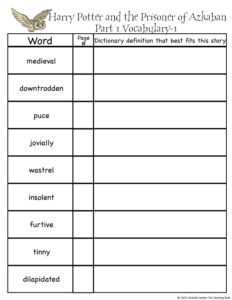
I also create another page that the student can attend to after they’ve completed their chapter reading. They will use their bookmark to locate the page number of the word. Next, they will look up the dictionary definition of the word and check it against the inference made on the bookmark as they read. You can see an example from my Harry Potter and the Prisoner of Azkaban Novel Study.
Each unit will contain some activities to work with the words and definitions, such as a crossword puzzle or word search.
I also like to work with grammar skills in context. My units contain a grammar skills activity for each vocabulary word that allows them to identify the part of speech of the word. There is also a sentence using the word written with improper grammar, missing punctuation, and misspellings. The student will need to correct the sentence to the proper written format. Here’s an example page from my Harry Potter and the Sorcerer’s Stone Novel Study.
All of my novel studies offer a Google Drive™ format, in addition to the printable format, shown above, to use with your students. This allows you to use novel studies in a 1:1 classroom, save paper, and easily engage students that are absent. Here’s an example page from the Google Drive™ format of my Harry Potter and the Half-Blood Prince Novel Study.
Pacing and approaching vocabulary in this manner has worked very well for me. It allows the students to think about the words and their meaning in context while not disrupting the story to learn the correct definitions.
Join me for part 3 of my series to learn the pacing methods I use for my novel studies.
Are you interested in reading about and sharing ideas with other educators on using children’s literature in your classroom? My goal is to bring together teachers and homeschoolers who teach grades 3-8 and use novels with their students. I’d love for you to join me to learn, share, and grow together!


 Novel Studies Part 5: Assessment
 I often get questions from potential buyers asking if there are assessments after every chapter of my novel studies. I kind of cringe when I get these questions because I can only imagine the dread the students must have if they are tested after every chapter! Testing is not the only way to assess if a student has read and understood. In my experience, class discussions and the writing in the comprehension answers are more than sufficient evidence of learning and understanding by the student. It is imperative when using novel studies not to lose focus and kill the joy of reading for your students! Your goal is for them to voluntarily pick up another book to read when a novel study is over, not run as far as they can from books!





 Connect with Fellow Educators!
 Novel Studies Part 4: The Extras!


 All of my novel studies offer a Google Drive™ format, in addition to the printable format, shown above, to use with your students. This allows you to use novel studies in a 1:1 classroom, save paper, and easily engage students who are absent. The “extras” of the novel study are included in the Google Drive™ format as well. Here’s an example page from the Google Drive™ format of my
 Novel Studies Part 3: Pacing

 All of my novel studies offer a Google Drive™ format, in addition to the printable format, shown above, to use with your students. This allows you to use novel studies in a 1:1 classroom, save paper, and easily engage students that are absent. Here’s an example page from the Google Drive™ format of my

 Novel Studies Part 2: Vocabulary/Grammar Skill Work
 When I create a novel study, I try and pick out all the words that would be unfamiliar to a reader while at the same time not overdoing it by having such a long list of words for each chapter that the reader is pulled from the story. Balance is imperative.
 I also like to work with grammar skills in context. My units contain a grammar skills activity for each vocabulary word that allows them to identify the part of speech of the word. There is also a sentence using the word written with improper grammar, missing punctuation, and misspellings. The student will need to correct the sentence to the proper written format. Here’s an example page from my
  All of my novel studies offer a Google Drive™ format, in addition to the printable format, shown above, to use with your students. This allows you to use novel studies in a 1:1 classroom, save paper, and easily engage students that are absent. Here’s an example page from the Google Drive™ format of my