The Harry Potter book series has captured the hearts of readers worldwide since its first publication in 1997. Harry Potter and the Half-Blood Prince, the sixth book in the series, is no exception. In fact, it has become a favorite among teachers as a tool to help students develop their language, critical thinking, and literary analysis skills.
We earn a commission if you make a purchase, at no additional cost to you.
Benefits of using Harry Potter and the Half-Blood Prince in your classroom:
Enhances Vocabulary and Language Skills: One of the most significant benefits of using Harry Potter and the Half-Blood Prince in the classroom is the enhancement of vocabulary and language skills. The book contains a vast array of words that may be unfamiliar to students that J.K. Rowling invented, such as “occlumency,” “horcrux,” and “pensieve.” Figuring out the meaning of these words using context clues can be used to develop students’ understanding of language, how it develops, and to increase their vocabulary. Additionally, the book contains a range of complex sentence structures and writing styles that can be used to teach grammar and punctuation.
Develops Critical Thinking and Analytical Skills:Harry Potter and the Half-Blood Prince can be used as a tool to develop critical thinking and analytical skills. The book contains numerous themes and subplots, including love, betrayal, and sacrifice. These themes can be used to engage students in critical thinking activities and encourage them to analyze and interpret the text. Students can also be asked to compare and contrast the characters, their motives, and their actions, which can further develop their analytical skills.
Promotes a Love of Reading: The Harry Potter series is known for its captivating storyline and engaging characters, making it an excellent tool to promote a love of reading among students. Using Harry Potter and the Half-Blood Prince in the classroom can inspire students to read more books, improve their reading skills, and foster a lifelong love of reading.
Provides Opportunities for Multimodal Learning: The Harry Potter series has been adapted into movies, which can be used as a tool to provide opportunities for multimodal learning in the classroom. Students can be asked to compare and contrast the book and movie versions, analyze the different modes of communication used in the movie, and explore the use of visual and audio elements to enhance the story.
Encourages Collaboration and Discussion: Using Harry Potter and the Half-Blood Prince in the classroom can encourage collaboration and discussion among students. Students can work in groups to analyze and interpret the text, discuss the themes and subplots, and explore the characters’ motivations and actions. This can promote social interaction, build teamwork skills, and encourage students to share their ideas and opinions with their peers.
Using Harry Potter and the Half-Blood Prince in your classroom can be a valuable tool to enhance your teaching experience and help your students develop their language, critical thinking, and literary analysis skills. It can also inspire a love of reading, provide opportunities for multimodal learning, and encourage collaboration and discussion among students. So, why not bring a little bit of magic into your classroom and see the benefits for yourself?
I offer a complete novel study to accompany Harry Potter and the Half-Blood Prince for use in the classroom or homeschool. The unit includes both a printable format and a Google Drive™ format for use in a paperless classroom or with Google Classroom.
Are you interested in reading about and sharing ideas with other educators on using children’s literature in your classroom? My goal is to bring together teachers and homeschoolers who teach grades 3-8 and use novels with their students. I’d love for you to join me to learn, share, and grow together!
Harry Potter and the Sorcerer’s Stone is a classic novel that has captured the hearts and minds of readers of all ages. It tells the story of a young boy named Harry Potter, who discovers that he is a wizard and attends Hogwarts School of Witchcraft and Wizardry. Through his adventures at Hogwarts, Harry learns about friendship, bravery, and the power of love.
We earn a commission if you make a purchase, at no additional cost to you.
Using Harry Potter and the Sorcerer’s Stone in the classroom can be a great way to engage students and make learning more fun. The book can be used to teach a variety of subjects, such as English, history, and even science. For example, students can analyze the characters and themes in the book, study the historical and cultural references, or even explore the magical concepts that are introduced. In addition to being an entertaining and educational read, Harry Potter and the Sorcerer’s Stone is also a great way to promote literacy and improve reading skills. The book is well-written and easy to follow, making it a good choice for readers of all levels. It also introduces students to new vocabulary and encourages them to think critically about the text.
Why should you use Harry Potter and the Sorcerer’s Stone in your classroom?
Popularity: Harry Potter and the Sorcerer’s Stone is a book that most students have heard of, if not already read. This familiarity can help students feel more invested in the material and motivated to learn.
Relatability: The characters in Harry Potter and the Sorcerer’s Stone are relatable and appeal to a wide range of readers. Students may see themselves in Harry, Hermione, or Ron, and this can help them connect with the story and learn important life lessons.
Diversity: The book introduces readers to a diverse cast of characters from different backgrounds and cultures. This can help promote empathy and understanding among students and encourage them to appreciate differences.
Themes: Harry Potter and the Sorcerer’s Stone explores important themes such as friendship, courage, and the power of love. These themes can be used to spark meaningful discussions and encourage students to reflect on their own values and beliefs.
By using Harry Potter and the Sorcerer’s Stone in your classroom, you can create a fun and engaging learning environment that promotes literacy, critical thinking, and empathy.
Try a free sample of the novel study for Harry Potter and the Sorcerer’s Stone
I offer a complete novel study to accompany Harry Potter and the Sorcerer’s Stone (which includes a format for the Philosopher’s Stone) for use in the classroom or homeschool. This includes both a printable format and a Google Drive™ format for use in a paperless classroom or with Google Classroom.
You can purchase this novel study at the following locations:
Are you interested in reading about and sharing ideas with other educators on using children’s literature in your classroom? My goal is to bring together teachers and homeschoolers who teach grades 3-8 and use novels with their students. I’d love for you to join me to learn, share, and grow together!
One way to engage your students and bring your lessons to life is by incorporating popular culture into your curriculum, and there’s no better example of this than the Harry Potter series. In particular, Harry Potter and the Order of the Phoenix can be an excellent tool for educators looking to engage their students and teach valuable lessons.
We earn a commission if you make a purchase, at no additional cost to you.
Benefits of using Harry Potter and the Order of the Phoenix in your classroom:
Provides Engaging and Relevant Material:Harry Potter and the Order of the Phoenix is a modern, popular, and well-known book, which makes it an excellent choice for engaging your students. Many students are likely already familiar with the story and characters, which can help to generate interest and enthusiasm for the subject matter. Additionally, the themes and lessons of the book are highly relevant to the lives of young people, making it an ideal text for teaching critical thinking and social-emotional skills.
Encourage Critical Thinking and Analysis: The Harry Potter series is a complex and multi-layered story, filled with symbolism, metaphors, and allegory. By using Harry Potter and the Order of the Phoenixin your classroom, you can teach critical thinking and analysis skills by asking students to identify and interpret these elements. For example, you can ask students to analyze the character development of Harry or to identify the symbols that appear throughout the book. These activities will help your students develop their analytical skills and become more adept at reading and interpreting literature.
Opportunities for Social-Emotional Learning: The characters in Harry Potter and the Order of the Phoenix face a range of challenges and struggles, from dealing with grief to standing up against authority. By exploring these themes in your classroom, you can help your students to develop their social-emotional skills. For example, you can ask students to consider the importance of friendship in the book or discuss the role of resilience in overcoming adversity. These discussions will help your students to become more empathetic, resilient, and compassionate individuals.
FostersCreativity and Imagination: The Harry Potter series is renowned for its vivid and imaginative world-building, and by using Harry Potter and the Order of the Phoenix in your classroom, you can foster creativity and imagination in your students. For example, you can ask students to create their own magical creatures or spells or to write their own fanfiction set in the wizarding world. These activities will help your students to develop their creativity and imagination, while also engaging with the themes and lessons of the book.
Provides Multidisciplinary Learning: The Harry Potter series can be used to teach a range of subjects and disciplines, from literature and language arts to social studies and even science. For example, you can use the book to teach about the history of magic or to explore the science behind potions and spells. By using Harry Potter and the Order of the Phoenixin your classroom, you can create a multidisciplinary learning experience that engages your students and helps them develop a range of skills and knowledge.
There are many benefits to using Harry Potter and the Order of the Phoenix in your classroom, from engaging your students and teaching critical thinking to fostering creativity and imagination. By incorporating this popular and relevant text into your curriculum, you can create a dynamic and engaging learning experience that will help your students develop a range of skills and knowledge.
I offer a complete novel study to accompany Harry Potter and the Order of the Phoenix for use in the classroom or homeschool. The unit includes both a printable format and a Google Drive™ format for use in a paperless classroom or with Google Classroom.
Are you interested in reading about and sharing ideas with other educators on using children’s literature in your classroom? My goal is to bring together teachers and homeschoolers who teach grades 3-8 and use novels with their students. I’d love for you to join me to learn, share, and grow together!
Some of my most vivid childhood memories of school were the novel studies I read for various subjects. It was my favorite way to learn skills, history, and any topic! I love books, and being allowed to read an entire book from cover to cover as a school assignment put me in heaven! I am sure this is a major reason why, as a teacher, my passion is to create and teach novel studies! I love introducing new books to my class, and as a community, being immersed in the book together. I love it when a student pulls us off the schedule with a question or comment from something they read and leads the class into a lively discussion. That’s where the real memorable learning takes place, after all!
I create novel studies more than any other product line simply because I like to focus on what I love. I want to work with my passion! I often get questions from readers asking how I would set up novel studies in my classroom. I decided to write a small series explaining my methods. For the most part, my novel studies include comprehension questions, vocabulary/grammar skill work, extension activities, and assessments.
Today’s post, part 3, deals with pacing the novel study. You can read part 1 and part 2 here.
Novel Studies Part 3: Pacing
One of the challenges of using novel studies in the classroom is finding the time. It’s a balance between not moving too fast and not letting the unit drag on for too long because we all know you have a million other things to squeeze into your curriculum!
Each of my complete novel studies includes detailed daily teacher lesson plans that include the objective and directions for the day. You can see how this is designed fo my Freak the Mighty Novel Study.
I also create a pacing guide for each novel study that helps you map out your long-range plan. You can see an example here from my Crenshaw Novel Study.
It’s a delicate balance to set the pacing. I generally try to aim for approximately 20 pages to read per day. This will be altered based on the chapter sizes. I don’t schedule split chapters as I feel this disrupts the reader. I know I hate to stop reading mid-chapter. That’s just mean!
All of my novel studies offer a Google Drive™ format, in addition to the printable format, shown above, to use with your students. This allows you to use novel studies in a 1:1 classroom, save paper, and easily engage students that are absent. Here’s an example page from the Google Drive™ format of my Wishtree Novel Study. The same pacing would apply for the Google™ version as you would use for the printable version.
This pacing is a suggestion as it has worked for me, but it is very adaptable, so you can work to fit it into the schedule that you are working with. The planning pages are written for a whole class novel study, but can be easily adapted to fit small book groups or individual novel studies. How much teacher interaction you want to have during the course of the study is up to you and can be worked in with the suggested pacing.
Join me for part 4 of my series to learn how I add extra experiences to my novel studies for deeper learning and growth.
Are you interested in reading about and sharing ideas with other educators on using children’s literature in your classroom? My goal is to bring together teachers and homeschoolers who teach grades 3-8 and use novels with their students. I’d love for you to join me to learn, share, and grow together!
Some of my most vivid childhood memories of school were the novel studies I read for various subjects. It was my favorite way to learn skills, history, and any topic! I love books, and being allowed to read an entire book from cover to cover as a school assignment put me in heaven! I am sure this is a major reason why, as a teacher, my passion is to create and teach novel studies! I love introducing new books to my class, and as a community, being immersed in the book together. I love it when a student pulls us off the schedule with a question or comment from something they read and leads the class into a lively discussion. That’s where the real memorable learning takes place, after all!
I create novel studies more than any other product line simply because I like to focus on what I love. I want to work with my passion! I often get questions from readers asking how I would set up novel studies in my classroom. I decided to write a small series explaining my methods. For the most part, my novel studies include comprehension questions, vocabulary/grammar skill work, extension activities, and assessments.
Today’s post, part 2, deals with the vocabulary/grammar skill aspect of the novel studies. You can read part 1 here.
Novel Studies Part 2: Vocabulary/Grammar Skill Work
One of the beautiful things about reading books is that it expands your vocabulary. It introduces you to new words that you can build into your commentary. Being exposed to these new words within the context of a story helps the reader infer the meaning of the word, and it helps to see the word used in action to help the student understand its relevance.
When I create a novel study, I try and pick out all the words that would be unfamiliar to a reader while at the same time not overdoing it by having such a long list of words for each chapter that the reader is pulled from the story. Balance is imperative.
I would always write the vocabulary words for the day/chapter on the board before starting the reading so the student would keep a lookout for those words as they read.
I create a vocabulary bookmark for the student to have in hand as they read. They can record the page number of the word and note the inference they made about the meaning of the word as they encountered it in context. You can see how this is designed for my Harry Potter and the Chamber of Secrets Novel Study.
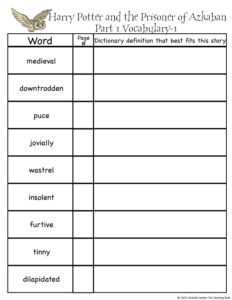
I also create another page that the student can attend to after they’ve completed their chapter reading. They will use their bookmark to locate the page number of the word. Next, they will look up the dictionary definition of the word and check it against the inference made on the bookmark as they read. You can see an example from my Harry Potter and the Prisoner of Azkaban Novel Study.
Each unit will contain some activities to work with the words and definitions, such as a crossword puzzle or word search.
I also like to work with grammar skills in context. My units contain a grammar skills activity for each vocabulary word that allows them to identify the part of speech of the word. There is also a sentence using the word written with improper grammar, missing punctuation, and misspellings. The student will need to correct the sentence to the proper written format. Here’s an example page from my Harry Potter and the Sorcerer’s Stone Novel Study.
All of my novel studies offer a Google Drive™ format, in addition to the printable format, shown above, to use with your students. This allows you to use novel studies in a 1:1 classroom, save paper, and easily engage students that are absent. Here’s an example page from the Google Drive™ format of my Harry Potter and the Half-Blood Prince Novel Study.
Pacing and approaching vocabulary in this manner has worked very well for me. It allows the students to think about the words and their meaning in context while not disrupting the story to learn the correct definitions.
Join me for part 3 of my series to learn the pacing methods I use for my novel studies.
Are you interested in reading about and sharing ideas with other educators on using children’s literature in your classroom? My goal is to bring together teachers and homeschoolers who teach grades 3-8 and use novels with their students. I’d love for you to join me to learn, share, and grow together!





 Novel Studies Part 3: Pacing

 All of my novel studies offer a Google Drive™ format, in addition to the printable format, shown above, to use with your students. This allows you to use novel studies in a 1:1 classroom, save paper, and easily engage students that are absent. Here’s an example page from the Google Drive™ format of my


 Novel Studies Part 2: Vocabulary/Grammar Skill Work
 When I create a novel study, I try and pick out all the words that would be unfamiliar to a reader while at the same time not overdoing it by having such a long list of words for each chapter that the reader is pulled from the story. Balance is imperative.
 I also like to work with grammar skills in context. My units contain a grammar skills activity for each vocabulary word that allows them to identify the part of speech of the word. There is also a sentence using the word written with improper grammar, missing punctuation, and misspellings. The student will need to correct the sentence to the proper written format. Here’s an example page from my
  All of my novel studies offer a Google Drive™ format, in addition to the printable format, shown above, to use with your students. This allows you to use novel studies in a 1:1 classroom, save paper, and easily engage students that are absent. Here’s an example page from the Google Drive™ format of my