Teaching the Holocaust to middle school students is difficult—but powerful literature can help students understand history in a deeply personal way.
Prisoner B-3087 by Alan Gratz is an especially compelling choice for a 5th–8th grade historical fiction novel study. Based on the true experiences of Holocaust survivor Jack Gruener, the novel follows Yanek, a young Jewish boy in Poland whose life is transformed by the Nazi occupation.
Through Yanek’s story, students encounter history not simply as dates and facts, but through the experiences of a child who faces unimaginable hardship, loss, fear, and uncertainty.
For teachers looking for a Holocaust novel study, World War II literature unit, or meaningful historical fiction book for middle school ELA, Prisoner B-3087 offers rich opportunities for reading comprehension, critical thinking, historical understanding, and discussions about empathy, resilience, and human rights.
Watch a video of Alan Gratz speaking with the real Jack (Yanek) Gruener HERE!
We earn a commission if you make a purchase, at no additional cost to you.
Why Teach Prisoner B-3087 in the Classroom?
Prisoner B-3087 provides much more than an engaging story. It creates opportunities for students to connect literature, history, social studies, and real-world issues while developing important reading and thinking skills.
1. Build Historical Understanding
Students can sometimes struggle to understand the enormity of historical events such as the Holocaust. Textbooks and timelines provide important information, but a novel can help students understand history from an individual perspective.
Following Yanek’s experiences allows students to see how the Holocaust affected an actual child and his family.
Throughout the novel, Yanek is forced to navigate increasingly dangerous circumstances and multiple concentration camps. His experiences help students understand the human impact of the Holocaust and World War II in a way that statistics alone cannot.
This makes Prisoner B-3087 an excellent addition to a World War II or Holocaust unit.
2. Develop Empathy and Compassion
Historical fiction allows students to step into the experiences of someone whose life may be very different from their own.
As students follow Yanek’s journey, they can consider questions such as:
What does it mean to survive when you have almost no control over your circumstances?
How do people maintain hope during unimaginable hardship?
What choices do people make when faced with fear and uncertainty?
How can ordinary people respond when others are being mistreated?
What can we learn from the experiences of Holocaust survivors?
These discussions can lead naturally into lessons about empathy, tolerance, prejudice, discrimination, human rights, and compassion.
3. Encourage Critical Thinking
A strong novel study should do more than ask students to recall what happened in each chapter.
Prisoner B-3087 gives students opportunities to analyze characters, examine themes, interpret events, make inferences, and support their ideas with evidence from the text.
Students can explore themes such as:
Resilience
Perseverance
Hope
Survival
Family
Friendship
Courage
Prejudice
Human dignity
The consequences of hatred
These themes provide excellent opportunities for higher-order thinking, literary analysis, and evidence-based writing.
4. Explore Resilience and Perseverance
One of the most powerful aspects of Yanek’s story is his determination to survive.
Despite losing so much, Yanek continues to persevere.
This creates an authentic opportunity to discuss resilience and perseverance with students—not as abstract character traits, but as qualities demonstrated by a real person in extraordinary circumstances.
Students can analyze the choices Yanek makes and consider what allows him to continue moving forward despite the obstacles he faces.
Connect Literature to Informational Text
One of the most valuable ways to teach historical fiction is to pair the novel with nonfiction reading.
When students learn about the historical events, people, and places referenced in a novel, they develop a deeper understanding of both the story and its historical context.
A Prisoner B-3087 novel study can be paired with informational texts about:
Kraków, Poland, from 1939–1942
Plaszów Concentration Camp
Amon Goeth
The Wieliczka Salt Mine
Trzebinia Concentration Camp
Birkenau
Auschwitz
The Death Marches of 1945
Sachsenhausen
Bergen-Belsen
Buchenwald
Gross-Rosen
Dachau
Post-war Munich
The Orphaned Jewish Visa Program
Oskar Schindler and Schindler’s List
These connections allow students to practice reading informational text while building historical background knowledge.
They also provide an excellent opportunity to compare what students learn from fictionalized storytelling with information presented in nonfiction sources.
Turn Prisoner B-3087 Into a Complete Novel Study
If you’re planning to teach Prisoner B-3087 as a whole-class novel, small-group book study, literature circle, or independent reading assignment, you don’t have to create every activity yourself.
The resource is designed for grades 5–8 and includes both printable PDF materials and digital Google Drive™ resources, making it flexible enough for traditional, paperless, and blended classrooms.
What’s Included in the Prisoner B-3087 Novel Unit?
The complete novel study includes:
Daily lesson plans
Pacing and standards guide
Chapter/section guide
Chapter-by-chapter comprehension questions
Vocabulary activities
Grammar activities
Spelling
Writing activities
Critical-thinking questions
Nonfiction reading passages
Historical background information
Assessments
Digital self-grading quizzes
Answer keys
Vocabulary word wall cards
Parent letter
Common Core ELA alignment
Printable student materials
Digital Google Drive™ materials
Instead of spending hours searching for Prisoner B-3087 comprehension questions, vocabulary activities, writing prompts, nonfiction passages, and assessments, you can have your complete novel unit ready to teach.
Make Your Prisoner B-3087 Unit More Than a Reading Assignment
A powerful novel study should help students do more than finish a book.
It should encourage them to read closely, ask questions, make connections, think critically, understand historical context, and reflect on what they have learned.
Prisoner B-3087 provides an excellent foundation for that kind of learning.
Students can connect ELA skills to social studies while exploring a significant period in history. They can analyze characters and themes while developing empathy. They can practice citing textual evidence while considering complex moral and ethical questions.
Most importantly, Yanek’s story can help students understand that history is made up of real people—with families, hopes, fears, dreams, and lives that were forever changed by the events around them.
Try a free sample of the novel study for Prisoner B-3087
Ready to Teach Prisoner B-3087?
If you’re looking for a no-prep Prisoner B-3087 novel study for grades 5–8, this complete unit is designed to save you planning time while providing meaningful ELA and historical learning opportunities.
Use it for a whole-class novel, small-group instruction, literature circles, reading intervention, homeschool, or independent study.
Connect with Fellow Educators!
Are you teaching Prisoner B-3087 this school year?
Join our free community, Book Talk with The Teaching Bank, to share ideas, grab freebies, and connect with 3rd–8th grade teachers using novels in the classroom!
*The Teaching Bank participates in the Amazon Associate Program and earns a fee from qualifying purchases made on the Amazon.com site.
Looking for an engaging novel study for The Voyage of the Dawn Treader that will get your students thinking, discussing, and making meaningful connections?
The Voyage of the Dawn Treader by C. S. Lewis is a wonderful choice for an upper elementary or middle school ELA classroom. As part of The Chronicles of Narnia, this classic fantasy novel takes students on an unforgettable journey across the sea while providing plenty of opportunities to explore character development, plot, vocabulary, themes, comprehension, and critical thinking.
We earn a commission if you make a purchase, at no additional cost to you.
Why Teach The Voyage of the Dawn Treader?
Few novels give students the opportunity to combine adventure and imagination with meaningful literary discussions quite like The Voyage of the Dawn Treader.
As students follow Edmund, Lucy, Eustace, and Caspian aboard the Dawn Treader, they encounter strange islands, unexpected challenges, and characters who must make difficult choices. These experiences create natural opportunities for classroom conversations and deeper reading comprehension.
Encourage Imagination and Creativity
C. S. Lewis’s vivid descriptions of Narnia and the journey aboard the Dawn Treader give students plenty to visualize. Encourage students to imagine the settings, creatures, and adventures they encounter throughout the novel.
This makes The Voyage of the Dawn Treader an excellent book for helping students connect descriptive language with visualization and creative thinking.
Develop Reading Comprehension and Critical Thinking
A good novel study should do more than ask students what happened in each chapter.
The Voyage of the Dawn Treader provides opportunities for students to think about why characters behave the way they do, how their choices affect the story, and how events contribute to the development of the plot.
Chapter-by-chapter comprehension questions can help students practice finding evidence in the text while moving beyond simple recall.
Explore Character Development
Eustace’s transformation is one of the most interesting character arcs in the novel.
Students can examine how his experiences affect him, how his relationships with the other characters change, and how challenges throughout the story contribute to his development.
These types of discussions make character development a natural focus for an ELA novel unit.
Discuss Themes and Life Lessons
The Voyage of the Dawn Treader offers many opportunities to discuss themes such as courage, selfishness, friendship, temptation, responsibility, and personal growth.
Rather than simply identifying a theme, students can explore how the author’s characters and events help develop those ideas throughout the story.
Build a Love of Reading
Perhaps one of the greatest benefits of teaching a classic novel like The Voyage of the Dawn Treader is the opportunity to introduce students to a larger world of literature.
Students who enjoy this adventure may want to continue reading The Chronicles of Narnia or explore other works by C. S. Lewis.
Make Your Voyage of the Dawn Treader Unit Easy to Teach
If you’re looking for a ready-to-use The Voyage of the Dawn Treader novel study, I’ve created a complete resource to help you teach the novel without spending hours creating worksheets, comprehension questions, assessments, and activities.
The Voyage of the Dawn Treader Novel Study includes both printable and digital Google Drive™ resources, making it flexible for traditional, paperless, and blended classrooms.
What’s Included?
This comprehensive novel study includes:
Teacher lesson plans and pacing guidance
Chapter-by-chapter comprehension questions
Vocabulary and grammar activities
Writing and extension activities
Assessments and answer keys
Literary analysis and story elements activities
Common Core standards alignment
Printable and Google Drive™ formats
Whether you use it for a whole-class novel study, small-group reading, literature circles, independent reading, or homeschool instruction, the ready-to-use activities make it easy to incorporate this classic into your ELA curriculum.
Try a free sample of the novel study for The Voyage of the Dawn Treader
If you’d like to see what teachers and students can do with these resources, be sure to download the free sample before you begin!
Ready to Set Sail?
Bring The Voyage of the Dawn Treader to life with engaging activities that encourage students to read closely, think critically, discuss literature, and make meaningful connections.
You can also explore my collection of Chronicles of Narnia novel studies if you’re looking for resources to accompany more of C. S. Lewis’s beloved books.
Connect with Fellow Educators!
Are you teaching The Voyage of the Dawn Treader this school year?
Join our free community, Book Talk with The Teaching Bank, to share ideas, grab freebies, and connect with 3rd–8th grade teachers using novels in the classroom!
*The Teaching Bank participates in the Amazon Associate Program and earns a fee from qualifying purchases made on the Amazon.com site.
Some of my most vivid childhood memories of school were the novel studies I read for various subjects. It was my favorite way to learn skills, history, and any topic! I love books, and being allowed to read an entire book from cover to cover as a school assignment put me in heaven! I am sure this is a major reason why, as a teacher, my passion is to create and teach novel studies! I love introducing new books to my class, and as a community, being immersed in the book together. I love it when a student pulls us off the schedule with a question or comment from something they read and leads the class into a lively discussion. That’s where the real memorable learning takes place, after all!
I create novel studies more than any other product line simply because I like to focus on what I love. I want to work with my passion! I often get questions from readers asking how I would set up novel studies in my classroom. I decided to write a small series explaining my methods. For the most part, my novel studies include comprehension questions, vocabulary/grammar skill work, extension activities, and assessments.
Today’s post, part 2, deals with the vocabulary/grammar skill aspect of the novel studies. You can read part 1 here.
Novel Studies Part 2: Vocabulary/Grammar Skill Work
One of the beautiful things about reading books is that it expands your vocabulary. It introduces you to new words that you can build into your commentary. Being exposed to these new words within the context of a story helps the reader infer the meaning of the word, and it helps to see the word used in action to help the student understand its relevance.
When I create a novel study, I try and pick out all the words that would be unfamiliar to a reader while at the same time not overdoing it by having such a long list of words for each chapter that the reader is pulled from the story. Balance is imperative.
I would always write the vocabulary words for the day/chapter on the board before starting the reading so the student would keep a lookout for those words as they read.
I create a vocabulary bookmark for the student to have in hand as they read. They can record the page number of the word and note the inference they made about the meaning of the word as they encountered it in context. You can see how this is designed for my Harry Potter and the Chamber of Secrets Novel Study.
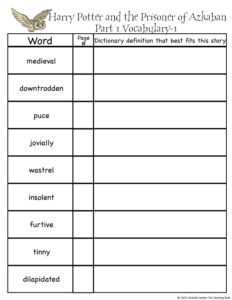
I also create another page that the student can attend to after they’ve completed their chapter reading. They will use their bookmark to locate the page number of the word. Next, they will look up the dictionary definition of the word and check it against the inference made on the bookmark as they read. You can see an example from my Harry Potter and the Prisoner of Azkaban Novel Study.
Each unit will contain some activities to work with the words and definitions, such as a crossword puzzle or word search.
I also like to work with grammar skills in context. My units contain a grammar skills activity for each vocabulary word that allows them to identify the part of speech of the word. There is also a sentence using the word written with improper grammar, missing punctuation, and misspellings. The student will need to correct the sentence to the proper written format. Here’s an example page from my Harry Potter and the Sorcerer’s Stone Novel Study.
All of my novel studies offer a Google Drive™ format, in addition to the printable format, shown above, to use with your students. This allows you to use novel studies in a 1:1 classroom, save paper, and easily engage students that are absent. Here’s an example page from the Google Drive™ format of my Harry Potter and the Half-Blood Prince Novel Study.
Pacing and approaching vocabulary in this manner has worked very well for me. It allows the students to think about the words and their meaning in context while not disrupting the story to learn the correct definitions.
Join me for part 3 of my series to learn the pacing methods I use for my novel studies.
Are you interested in reading about and sharing ideas with other educators on using children’s literature in your classroom? My goal is to bring together teachers and homeschoolers who teach grades 3-8 and use novels with their students. I’d love for you to join me to learn, share, and grow together!
“Everybody is a genius. But if you judge a fish by its ability to climb a tree, it will live its whole life believing that it is stupid.”
This a great quote that is often mistakenly attributed to Albert Einstein. He didn’t say this, but the quote is powerful, just the same.
This quote is the premise of the book Fish in a Treeby Lynda Mullaly Hunt.
Why Teach Fish in a Tree?
Fish in a Tree is a high-interest novel that can generate thoughtful classroom conversations while helping students connect reading to real-life experiences.
The story follows Ally Nickerson, a bright student who has struggled in school because she has difficulty reading. Because she doesn’t understand why reading is so difficult for her, Ally develops strategies to hide her struggles from her teachers and classmates.
When a new teacher recognizes Ally’s strengths and begins looking at her abilities differently, Ally starts to see herself differently, too.
This makes Fish in a Tree particularly valuable for discussions about:
Perseverance and resilience
Learning differences
Self-confidence
Friendship
Empathy
Bullying and kindness
Character growth
Overcoming challenges
The importance of supportive teachers
Seeing strengths instead of weaknesses
These themes give students much more to think about than simply answering questions about what happened in each chapter.
We earn a commission if you make a purchase, at no additional cost to you.
Looking for a Fish in a Tree novel study that will help your students dig deeper into the story while making your life as a teacher easier?
Fish in a Tree by Lynda Mullaly Hunt is an excellent choice for upper elementary and middle school readers. Through Ally’s experiences with reading, school, friendship, and learning differences, students have countless opportunities to explore character development, perseverance, empathy, identity, friendship, and overcoming challenges.
But teaching an entire novel can take a lot of planning.
That’s where a well-designed Fish in a Tree book unit can save you hours of preparation while giving students meaningful opportunities to practice reading comprehension, vocabulary, writing, critical thinking, and more.
Fish in a Tree Reading Comprehension
One of the best ways to use Fish in a Tree in the classroom is to give students opportunities to think deeply about what they are reading.
Instead of asking students to simply recall facts from each chapter, use Fish in a Tree comprehension questions that require students to explain their thinking.
For example, students can be asked to consider:
Why does Ally try so hard to hide her difficulties?
How do Ally’s relationships with her classmates change throughout the novel?
How does Mr. Daniels help Ally see herself differently?
What evidence shows that Ally is more capable than she believes?
How do the characters’ actions demonstrate empathy or a lack of empathy?
How does Ally change from the beginning of the novel to the end?
Don’t Overload Students With Questions
A novel study doesn’t need to turn every chapter into a worksheet marathon.
When students are reading a great book, you want them to become immersed in the story. Too many questions can interrupt that experience.
That’s why I prefer using a smaller number of thoughtful questions that require students to explain, infer, analyze, and connect their ideas to the text.
The goal is to create thoughtful readers—not students who simply race through a checklist of questions.
Fish in a Tree Vocabulary Activities
Fish in a Tree also provides plenty of opportunities for vocabulary instruction.
Rather than teaching vocabulary words in isolation, students can encounter new words in the context of the novel and then apply them through activities that reinforce both vocabulary and language skills.
A Fish in a Tree vocabulary unit can include activities such as:
Vocabulary definitions
Context clues
Spelling practice
Vocabulary word walls
Grammar activities
Word searches
Crossword puzzles
Written responses
Teaching vocabulary alongside the novel allows students to see how words function within authentic text while building their overall language skills.
Fish in a Tree Writing Activities
The themes in Fish in a Tree naturally lend themselves to writing.
Students can write about characters, themes, personal connections, and the challenges presented throughout the story.
Consider incorporating writing prompts that ask students to:
Explain how a character changes throughout the novel.
Describe a time when a character demonstrates perseverance.
Explain the importance of friendship in the story.
Compare how different characters respond to challenges.
Support an opinion with evidence from the novel.
Explain an important theme and how it develops.
Make connections between the novel and real-life experiences.
These types of Fish in a Tree writing activities help students move beyond basic comprehension and practice communicating their ideas clearly.
Go Beyond the Novel With STEM & Research
One of the things I love about using a complete novel for instruction is the opportunity to connect reading with other subject areas.
Fish in a Tree provides a natural opportunity to explore dyslexia and learning differences through nonfiction research.
Students can investigate what dyslexia is, learn more about how people with dyslexia experience reading, and consider how misconceptions about learning differences can affect students.
The novel can become the starting point for meaningful conversations about how people learn differently and why understanding and empathy matter.
A novel study can also incorporate STEM and other cross-curricular activities to keep students engaged while reinforcing the connections between reading and the world around them.
Fish in a Tree Lesson Plans That Save You Time
One of the biggest challenges of teaching a novel is simply figuring out what to do each day.
How many chapters should students read?
Which skills should you teach?
When should you assess comprehension?
What vocabulary should you focus on?
What activities should you add?
A complete Fish in a Tree lesson plan can take care of much of that planning for you.
Instead of starting from scratch, you can follow a structured pacing guide with daily objectives and activities and then adjust the schedule to fit your students.
This is especially helpful when using Fish in a Tree with:
Because Fish in a Tree works well with a range of upper-elementary and middle-school readers, it can be used with grades 5–8.
Of course, students within the same grade can have very different reading abilities. A good novel study should give you enough flexibility to adjust assignments and expectations for your particular students.
The same novel can be used for whole-class instruction, small groups, or independent study.
Printable + Digital Fish in a Tree Novel Study
If you’re looking for a no-prep Fish in a Tree novel study, I’ve created a complete unit that includes both printable and Google Drive™ formats.
That means you can use the materials in a traditional paper-based classroom or digitally with students using computers or tablets.
Not sure if this novel study is right for your students?
You can try a FREE Fish in a Tree novel study sample before purchasing the complete unit.
The free sample includes the activities for Chapters 1–2, so you can see exactly how the novel study works with your students.
Get the Complete Fish in a Tree Novel Study
If you’re planning to teach Fish in a Tree this year, you don’t have to spend your evenings creating comprehension questions, vocabulary activities, assessments, lesson plans, and extension activities.
The complete Fish in a Tree Novel Study includes everything you need to turn the novel into a meaningful, standards-aligned reading unit.
It is designed for grades 5–8 and includes both printable and Google Drive™ formats, making it flexible enough for traditional classrooms, digital learning, small groups, or homeschool.
📚 Save Time. Teach the Novel. Build Stronger Readers.
Connect with Fellow Educators!
Are you teaching Fish in a Tree this school year?
Join our free community, Book Talk with The Teaching Bank, to share ideas, grab freebies, and connect with 3rd–8th grade teachers using novels in the classroom!
*The Teaching Bank participates in the Amazon Associate Program and earns a fee from qualifying purchases made on the Amazon.com site.
Number the Stars by Lois Lowry is a powerful historical fiction novel that gives upper-elementary and middle-grade students an opportunity to explore courage, friendship, resistance, empathy, and standing up against injustice.
Set in Denmark during World War II, the novel follows Annemarie Johansen and her family as they help their Jewish friends escape the Nazi occupation. Through Annemarie’s eyes, students encounter a difficult period in history while experiencing a story that is accessible, engaging, and filled with opportunities for meaningful discussion.
If you’re planning a Number the Stars novel study for your 4th, 5th, or 6th grade students, this guide will give you ideas for connecting the novel to reading comprehension, vocabulary, critical thinking, history, and social-emotional learning.
We earn a commission if you make a purchase, at no additional cost to you.
Why Teach Number the Stars?
One of the greatest strengths of Number the Stars is that it allows students to encounter history through the experiences of a child.
Rather than simply reading facts about World War II, students follow Annemarie as she begins to understand what is happening around her. This creates natural opportunities to discuss questions such as:
What does it mean to be courageous?
Why do people sometimes have to make difficult choices?
How can ordinary people respond when others are being treated unfairly?
What makes someone a good friend?
How do fear and courage influence the decisions people make?
Why is it important to learn about difficult moments in history?
These questions can move students beyond simple recall and toward deeper reading comprehension and critical thinking.
Teaching Historical Fiction Through Number the Stars
Number the Stars works particularly well as a historical fiction novel because students can examine both the story and the historical context surrounding it.
As students read, encourage them to distinguish between what is happening in the fictional story and what they can learn about the real historical events that inspired it.
You can explore:
World War II
Nazi-occupied Denmark
The Danish Resistance
The rescue of Danish Jews
The Holocaust
Geography of Denmark and Sweden
Courage and resistance
Friendship and loyalty
Prejudice and discrimination
Human rights
This makes Number the Stars an excellent choice for connecting ELA and social studies.
Number the Stars Reading Comprehension
A novel study shouldn’t turn a great book into a stack of worksheets.
The goal is to help students think more deeply about what they’re reading while still allowing them to become immersed in the story.
When teaching Number the Stars, comprehension questions can focus on:
Character motivations
Making inferences
Cause and effect
Predicting
Making connections
Identifying themes
Using text evidence
Analyzing character development
Understanding historical context
I recommend using a small number of thoughtful questions rather than overwhelming students with questions after every few pages.
The questions should encourage students to explain why they think something happened—not simply identify what happened.
Vocabulary and Grammar in Context
Number the Stars also provides an excellent opportunity to teach vocabulary in context.
Instead of giving students a long list of unrelated vocabulary words, have them encounter words as they appear within the story.
Students can:
Determine meaning from context
Identify parts of speech
Use new words in sentences
Practice spelling
Explore synonyms and related words
Apply vocabulary through writing
This approach allows vocabulary instruction to become part of the reading experience rather than something completely separate from the novel.
The unit can be used with a whole class, small reading group, homeschool student, or independent reader. It includes both printable materials and digital resources for Google Drive.
What’s Included?
The complete Number the Stars Novel Study includes:
Teacher Resources
Detailed daily lesson plans
Pacing and Standards Guide
Chapter/Section Guide
Vocabulary Word Wall Cards
Answer Keys
Parent Letter
Student Resources
Spelling list
Vocabulary activities
Grammar activities
Chapter-by-chapter comprehension questions
Short-answer questions designed to encourage deeper thinking
Book-related extension activities
End-of-book activities
Story Elements Interactive Notebook activities
Assessment Resources
Part 1 assessment covering Chapters 1–6
Part 2 assessment covering Chapters 7–end
Vocabulary questions
Comprehension questions
Essay questions
Digital assessment options
The unit also includes Common Core Standards alignment for grades 4–6.
Print or Digital? You Get Both!
Today’s classrooms aren’t one-size-fits-all, so this novel study includes both printable and Google Drive-compatible formats.
Use the printable version for traditional instruction, or assign the digital activities through your classroom platform.
The digital format can be especially helpful for:
1:1 classrooms
Paperless classrooms
Students working from home
Absent students
Small-group instruction
Independent work
The assessments also include digital options, with multiple-choice Google Forms quizzes available for self-grading.
Save Time With a Ready-to-Teach Novel Unit
Teaching an entire novel is rewarding, but the planning can be time-consuming.
This Number the Stars novel unit was created to give you a complete framework so you don’t have to create every comprehension question, vocabulary activity, lesson plan, and assessment yourself.
It is designed to be low-prep and ready to teach, while still giving you flexibility to adjust the pacing and activities for your students.
You can purchase this novel study at the following locations:
💬 Connect with Fellow Educators!
Are you teaching Number the Stars this school year? How do you celebrate kindness in your classroom?
Join our free community, Book Talk with The Teaching Bank, to share ideas, grab freebies, and connect with 3rd–8th grade teachers using novels in the classroom!
*The Teaching Bank participates in the Amazon Associate Program and earns a fee from qualifying purchases made on the Amazon.com site.






 Connect with Fellow Educators!


 Novel Studies Part 2: Vocabulary/Grammar Skill Work
 When I create a novel study, I try and pick out all the words that would be unfamiliar to a reader while at the same time not overdoing it by having such a long list of words for each chapter that the reader is pulled from the story. Balance is imperative.
 I also like to work with grammar skills in context. My units contain a grammar skills activity for each vocabulary word that allows them to identify the part of speech of the word. There is also a sentence using the word written with improper grammar, missing punctuation, and misspellings. The student will need to correct the sentence to the proper written format. Here’s an example page from my
  All of my novel studies offer a Google Drive™ format, in addition to the printable format, shown above, to use with your students. This allows you to use novel studies in a 1:1 classroom, save paper, and easily engage students that are absent. Here’s an example page from the Google Drive™ format of my


