Some of my most vivid childhood memories of school were the novel studies I read for various subjects. It was my favorite way to learn skills, history, and any topic! I love books, and being allowed to read an entire book from cover to cover as a school assignment put me in heaven! I am sure this is a major reason why, as a teacher, my passion is to create and teach novel studies! I love introducing new books to my class, and as a community, being immersed in the book together. I love it when a student pulls us off the schedule with a question or comment from something they read and leads the class into a lively discussion. That’s where the real memorable learning takes place, after all!
I create novel studies more than any other product line simply because I like to focus on what I love. I want to work with my passion! I often get questions from readers asking how I would set up novel studies in my classroom. I decided to write a small series explaining my methods. For the most part, my novel studies include comprehension questions, vocabulary/grammar skill work, extension activities, and assessments.
Today’s post, part 2, deals with the vocabulary/grammar skill aspect of the novel studies. You can read part 1 here.
Novel Studies Part 2: Vocabulary/Grammar Skill Work
One of the beautiful things about reading books is that it expands your vocabulary. It introduces you to new words that you can build into your commentary. Being exposed to these new words within the context of a story helps the reader infer the meaning of the word, and it helps to see the word used in action to help the student understand its relevance.
When I create a novel study, I try and pick out all the words that would be unfamiliar to a reader while at the same time not overdoing it by having such a long list of words for each chapter that the reader is pulled from the story. Balance is imperative.
I would always write the vocabulary words for the day/chapter on the board before starting the reading so the student would keep a lookout for those words as they read.
I create a vocabulary bookmark for the student to have in hand as they read. They can record the page number of the word and note the inference they made about the meaning of the word as they encountered it in context. You can see how this is designed for my Harry Potter and the Chamber of Secrets Novel Study.
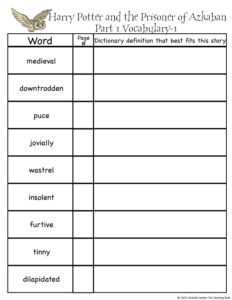
I also create another page that the student can attend to after they’ve completed their chapter reading. They will use their bookmark to locate the page number of the word. Next, they will look up the dictionary definition of the word and check it against the inference made on the bookmark as they read. You can see an example from my Harry Potter and the Prisoner of Azkaban Novel Study.
Each unit will contain some activities to work with the words and definitions, such as a crossword puzzle or word search.
I also like to work with grammar skills in context. My units contain a grammar skills activity for each vocabulary word that allows them to identify the part of speech of the word. There is also a sentence using the word written with improper grammar, missing punctuation, and misspellings. The student will need to correct the sentence to the proper written format. Here’s an example page from my Harry Potter and the Sorcerer’s Stone Novel Study.
All of my novel studies offer a Google Drive™ format, in addition to the printable format, shown above, to use with your students. This allows you to use novel studies in a 1:1 classroom, save paper, and easily engage students that are absent. Here’s an example page from the Google Drive™ format of my Harry Potter and the Half-Blood Prince Novel Study.
Pacing and approaching vocabulary in this manner has worked very well for me. It allows the students to think about the words and their meaning in context while not disrupting the story to learn the correct definitions.
Join me for part 3 of my series to learn the pacing methods I use for my novel studies.
Are you interested in reading about and sharing ideas with other educators on using children’s literature in your classroom? My goal is to bring together teachers and homeschoolers who teach grades 3-8 and use novels with their students. I’d love for you to join me to learn, share, and grow together!
Some of my most vivid childhood memories of school were the novel studies I read for various subjects. It was my favorite way to learn skills, history, and any topic! I love books, and being allowed to read an entire book from cover to cover as a school assignment put me in heaven! I am sure this is a major reason why, as a teacher, my passion is to create and teach novel studies! I love introducing new books to my class, and as a community, being immersed in the book together. I love it when a student pulls us off the schedule with a question or comment from something they read and leads the class into a lively discussion. That’s where the real memorable learning takes place, after all!
I create novel studies more than any other product line simply because I like to focus on what I love. I want to work with my passion! I often get questions from readers asking how I would set up novel studies in my classroom. I decided to write a small series explaining my methods. For the most part, my novel studies include comprehension questions, vocabulary/grammar skill work, extension activities, and assessments. Today’s post, part 1, deals with the comprehension aspect of the novel studies.
Novel Studies Part 1: Comprehension
One of the most compelling reasons to use whole novels in your reading instruction is to boost comprehension skills. A complete novel allows the student to delve deep into the characters’ minds and work through the plot from a detailed beginning to an end. You can’t achieve this level of deep understanding and thinking using short passages only. Students should be exposed to all methods of reading instruction, and complete novel studies fulfill a critical piece of the puzzle.
For students to dig deep into comprehension, they need the time to get lost in the narrative. Complete chapters will help them fall into the world of their book. The goal here is for students to think at the higher levels of the analysis and evaluation levels of Bloom’s Taxonomy.
To achieve this, I only use narrative questioning for my novel studies. The student needs to write out a complete statement in order to answer the question. Multiple-choice questions are not adequate to get the student to move beyond the lowest level of knowledge questioning of Bloom’s. You don’t want students doing quick guessing games to show what they’ve learned as they move through the book!
You can see that the questions will not allow the student to quick-skim the book. They can only answer if they’ve read, and the questions force them to think through what the character is thinking and put themselves into the character’s shoes. This type of questioning will take the student to the highest levels of both the cognitive and affective domains of Bloom’s Taxonomy.
You can also see that there are only five questions for the chapter. The questioning I use in my novel studies is usually only 1-6 questions per chapter. Students shouldn’t be inundated with questions in order to dig deep and show an understanding of what they’ve read. If the questioning is thorough, only a few questions are needed. I try to have at least one question per chapter, no matter how small it is. Of course, sometimes it is not necessary to assign a question just for the sake of assigning work if the chapter is too short.
Another reason for not overburdening the students with questions is to minimize the disruptions as they read. The more often they have to stop to answer questions, the less likely they are to get lost in the story. You want them to go all in!
All of my novel studies offer a Google Drive™ format, in addition to the printable format, shown above, to use with your students. This allows you to use novel studies in a 1:1 classroom, save paper, and easily engage students who are absent. Here’s an example page from the Google Drive™ format of my Esperanza Rising Novel Study.
Going through a story in this manner in regard to comprehension has worked very well for me. It forces those reluctant readers to put forth the effort to let themselves read deeply. The non-reluctant readers will be thrilled to be reading a complete book, so you’ve already hooked them!
Join me for part 2 in my series to learn the methods I use to try to turn my students into book detectives with vocabulary/grammar skill work using novel studies.
Are you interested in reading about and sharing ideas with other educators on using children’s literature in your classroom? My goal is to bring together teachers and homeschoolers who teach grades 3-8 and use novels with their students. I’d love for you to join me to learn, share, and grow together!
The reality of educational research is this: if you look hard enough, you can find support for almost any teaching strategy. Rarely is there a clear-cut answer about what works best. In most cases, effective teaching comes down to a teacher’s professional judgment, their students’ needs, and the flexibility they are given in the classroom.
Unfortunately, in today’s test-driven educational climate, teachers are often given less freedom than ever before. Rigid curriculum guidelines and scripted programs can make it difficult to adapt instruction, leaving little room for meaningful engagement or enrichment.
My Experience Using Novel Studies in the Classroom
I experienced this challenge firsthand while teaching 4th grade in a high-poverty, low-performing school. Many of my students entered my classroom reading at a 1st–2nd grade level, and very few were on grade level.
The biggest obstacle wasn’t just skill; it was motivation.
Our district relied heavily on a basal reading program that felt unrelatable and uninspiring to students. The stories lacked emotional connection, and students saw reading as a chore rather than something enjoyable or rewarding.
I knew something had to change.
How Read-Alouds Spark a Love of Reading
I started small by implementing a daily read-aloud time. My goal wasn’t rigorous analysis; I simply wanted students to enjoy a story.
This shift made a huge difference.
Upper elementary students are often overlooked when it comes to being read to, yet they benefit tremendously from it. By choosing high-interest, often humorous books, I was able to create a positive reading experience. Soon, read-aloud became one of the most anticipated parts of our day.
Why Novel Studies Work Better Than Basal Readers
Once I saw the impact of read-alouds, I began incorporating novel studies alongside our required curriculum.
Instead of limiting students to short excerpts, I introduced full novels connected to the themes in our basal program. The results were immediate and powerful:
Students reading below grade level began attempting more challenging texts
Engagement and participation increased dramatically
Discussions became deeper and more meaningful
Students started choosing to read independently
It became clear that reading an entire book provides a richer, more rewarding experience than isolated passages.
Improved Critical Thinking Through Deeper Reading
One of the biggest advantages of novel studies is the ability to promote higher-order thinking.
With a full-length text, students can:
Analyze character development
Explore complex themes
Make predictions and connections
Engage in meaningful discussions
Using Bloom’s Taxonomy becomes far more natural when students are immersed in a complete story rather than a short excerpt.
Building Real-World Connections and Empathy
Perhaps the most powerful benefit of novel studies is their ability to build empathy and awareness.
Through literature, students can explore real-world issues in a meaningful and age-appropriate way. For example:
These stories stay with students far longer than any worksheet ever could.
Do Novel Studies Improve Test Scores?
While I didn’t conduct formal research, I can confidently say this: My students’ test scores did not decline, and their love of reading increased significantly.
And that matters.
Because when students enjoy reading, they read more. And when they read more, their skills naturally improve.
Key Benefits of Using Novel Studies in the Classroom
Incorporating novel studies into your curriculum offers numerous advantages:
Improved Reading Skills: Students build comprehension, vocabulary, and fluency through sustained reading.
Increased Student Engagement: Novels capture interest and create emotional investment in learning.
Stronger Critical Thinking Skills: Students analyze, infer, and evaluate as they explore complex texts.
Enhanced Writing and Communication: Discussions and written responses deepen understanding and expression.
Greater Cultural Awareness: Literature exposes students to diverse perspectives and experiences.
Development of Empathy: Students connect with characters and better understand others’ experiences.
Encouragement of Independent Reading: Engaged students are more likely to read on their own.
Final Thoughts: Why Novel Studies Matter
Using novel studies in the classroom is one of the most effective ways to transform reading instruction.
While standardized programs may check boxes, novels create meaningful learning experiences. They engage students, deepen understanding, and foster a lifelong love of reading.
And ultimately, that’s what great teaching is all about.
Are you interested in reading about and sharing ideas with other educators on using children’s literature in your classroom? My goal is to bring together teachers and homeschoolers who teach grades 3-8 and use novels with their students. I’d love for you to join me to learn, share, and grow together!
In the pursuit of a well-rounded education, teachers need to explore diverse and culturally rich literature that engages and inspires their students. One such gem is Esperanza Rising by Pam Muñoz Ryan. This poignant novel not only captivates young readers but also offers numerous educational benefits. From promoting empathy and cultural understanding to fostering critical thinking and historical awareness, incorporating Esperanza Rising in the classroom can be a transformative experience for both teachers and students.
We earn a commission if you make a purchase, at no additional cost to you.
The advantages of using Esperanza Rising in your classroom:
Cultivate Empathy and Cultural Understanding: Esperanza Rising is a gripping tale that follows the life of Esperanza Ortega, a young girl whose life takes an unexpected turn when she is forced to leave her privileged life in Mexico and start anew in a California labor camp during the Great Depression. The novel eloquently portrays the challenges faced by immigrant families and workers, highlighting themes of resilience, perseverance, and the pursuit of the American Dream.
By exploring Esperanza’s journey, students gain a deeper understanding of the struggles faced by immigrants and those from diverse backgrounds. As students connect with the characters and their experiences, empathy is cultivated, and cultural understanding is fostered. This empathy can lead to a more compassionate and inclusive classroom environment.
Spark Discussions on Social Justice and Human Rights: Esperanza Rising provides an excellent platform for engaging classroom discussions on social justice and human rights. Students can critically examine the harsh realities of migrant labor during the 1930s, drawing parallels to contemporary issues related to workers’ rights and socio-economic inequality. By analyzing the historical context and the character’s motivations, students can develop a nuanced perspective on societal challenges, inspiring them to seek positive change in their own communities.
Enhance Critical Thinking and Literary Analysis: With its rich symbolism, intricate character development, and vivid imagery, Esperanza Rising offers ample opportunities for literary analysis and critical thinking. Teachers can encourage students to explore the thematic elements, such as family, loss, identity, and sacrifice. Discussing the novel’s underlying messages can foster a deeper appreciation for literature and hone critical thinking skills.
Additionally, teachers can incorporate activities that encourage students to compare and contrast Esperanza Rising with other literary works, as well as with real-life events. This interdisciplinary approach promotes a broader understanding of literature’s relevance to historical and contemporary contexts.
Advance Language and Writing Skills: Using Esperanza Rising in the classroom can also aid in language development and writing skills. The novel’s lyrical prose and evocative language expose students to literary excellence, expanding their vocabulary and language comprehension. Furthermore, teachers can design writing assignments that encourage students to reflect on characters’ motivations, write journal entries from the characters’ perspectives, or even craft their own narratives inspired by the novel.
Encourage Resilience and Personal Growth: The protagonist, Esperanza, undergoes significant personal growth and resilience throughout the story. Her journey from a sheltered girl to a strong and self-reliant young woman serves as a powerful example for students facing challenges in their own lives. By analyzing Esperanza’s character arc, students can draw valuable life lessons, such as the importance of perseverance and adapting to change.
Esperanza Rising is an extraordinary novel that brings forth a multitude of benefits when used in the classroom. From fostering empathy and cultural understanding to nurturing critical thinking and personal growth, this book has the power to transform students’ lives. As teachers, introducing this captivating narrative into our educational curriculum can create a deeper appreciation for literature and a greater understanding of the world around us. By embracing the diverse perspectives presented in Esperanza Rising, we can create an inclusive learning environment that empowers our students to become compassionate and thoughtful global citizens.
I offer a complete novel study to accompany Esperanza Rising for use in the classroom or homeschool. The unit includes both a printable format and a Google Drive™ format for use in a paperless classroom or with Google Classroom.
Try a free sample of the novel study for Esperanza Rising
You can purchase this novel study at the following locations:
Are you interested in reading about and sharing ideas with other educators on using children’s literature in your classroom? My goal is to bring together teachers and homeschoolers who teach grades 3-8 and use novels with their students. I’d love for you to join me to learn, share, and grow together!
Some of my most vivid childhood memories of school were the novel studies I read for various subjects. It was my favorite way to learn skills, history, and any topic! I love books, and being allowed to read an entire book from cover to cover as a school assignment put me in heaven! I am sure this is a major reason why, as a teacher, my passion is to create and teach novel studies! I love introducing new books to my class, and as a community, being immersed in the book together. I love it when a student pulls us off the schedule with a question or comment from something they read and leads the class into a lively discussion. That’s where the real memorable learning takes place, after all!
I create novel studies more than any other product line simply because I like to focus on what I love. I want to work with my passion! I often get questions from readers asking how I would set up novel studies in my classroom. I decided to write a small series explaining my methods. For the most part, my novel studies include comprehension questions, vocabulary/grammar skill work, extension activities, and assessments.
Today’s post, part 5, is the conclusion of the series dealing with the assessment aspect of using novel studies. You can read Part 1, Part 2, Part 3, and Part 4 here.
Novel Studies Part 5: Assessment
Assessment of a novel study can be a tricky thing to handle. My main objective, in addition to hitting skills, is to hook the student on the enjoyment of reading a good book. Too much assessment can kill that joy, but we need some way to assess that the skills are met. It’s a delicate balance.
I often get questions from potential buyers asking if there are assessments after every chapter of my novel studies. I kind of cringe when I get these questions because I can only imagine the dread the students must have if they are tested after every chapter! Testing is not the only way to assess if a student has read and understood. In my experience, class discussions and the writing in the comprehension answers are more than sufficient evidence of learning and understanding by the student. It is imperative when using novel studies not to lose focus and kill the joy of reading for your students! Your goal is for them to voluntarily pick up another book to read when a novel study is over, not run as far as they can from books!
I understand that assessments are helpful and necessary, but they should be appropriate and not overwhelming. For many of my novel studies, I have split the book into logical sections and have an assessment after each section. For example, you’ll find my Wonder,Projekt 1065, and Tuck Everlastingnovel studies in this format.
For some, I only offer assessments after completion of the book for comprehension, vocabulary, and longer paragraph-writing essay questions. The end-of-the-novel comprehension quiz includes both a multiple-choice and a short answer format for differentiation. A multiple-choice quiz for vocabulary and a paragraph-writing assessment is included with each novel study. You can see an example of this from my Turtle in Paradise Novel Study.
All of my novel studies offer a Google Drive™ format, in addition to the printable format, shown above, to use with your students. This allows you to use novel studies in a 1:1 classroom, save paper, and easily engage students who are absent. The assessments are included as multiple-choice questions in a Google Forms™ format so that they are self-grading. Here’s an example page from the Google Drive™ format of my A Wrinkle in Time Novel Study.
The key, in my opinion, is not to overdo the testing. You need to be able to assess the students’ understanding of what they are reading, which can be done in many different ways that aren’t paper and pencil testing. Don’t kill the love the student is developing for the book you are reading!
I hope this series has been helpful to you in planning to use novels in your classroom. I promise you will not be sorry, you may just be the spark that takes your student on a lifetime love of reading!
Are you interested in reading about and sharing ideas with other educators on using children’s literature in your classroom? My goal is to bring together teachers and homeschoolers who teach grades 3-8 and use novels with their students. I’d love for you to join me to learn, share, and grow together!


 Novel Studies Part 2: Vocabulary/Grammar Skill Work
 When I create a novel study, I try and pick out all the words that would be unfamiliar to a reader while at the same time not overdoing it by having such a long list of words for each chapter that the reader is pulled from the story. Balance is imperative.
 I also like to work with grammar skills in context. My units contain a grammar skills activity for each vocabulary word that allows them to identify the part of speech of the word. There is also a sentence using the word written with improper grammar, missing punctuation, and misspellings. The student will need to correct the sentence to the proper written format. Here’s an example page from my Harry Potter and the Sorcerer’s Stone Novel Study.
 All of my novel studies offer a Google Drive™ format, in addition to the printable format, shown above, to use with your students. This allows you to use novel studies in a 1:1 classroom, save paper, and easily engage students that are absent. Here’s an example page from the Google Drive™ format of my Harry Potter and the Half-Blood Prince Novel Study.


 Novel Studies Part 1: Comprehension

 All of my novel studies offer a Google Drive™ format, in addition to the printable format, shown above, to use with your students. This allows you to use novel studies in a 1:1 classroom, save paper, and easily engage students who are absent. Here’s an example page from the Google Drive™ format of my





 Novel Studies Part 5: Assessment
 I often get questions from potential buyers asking if there are assessments after every chapter of my novel studies. I kind of cringe when I get these questions because I can only imagine the dread the students must have if they are tested after every chapter! Testing is not the only way to assess if a student has read and understood. In my experience, class discussions and the writing in the comprehension answers are more than sufficient evidence of learning and understanding by the student. It is imperative when using novel studies not to lose focus and kill the joy of reading for your students! Your goal is for them to voluntarily pick up another book to read when a novel study is over, not run as far as they can from books!


