Sadako and the Thousand Paper Cranes by Eleanor Coerr is a book that has been widely used in classrooms around the world. It is a story that teaches children about the horrors of war and the importance of peace.
We earn a commission if you make a purchase, at no additional cost to you.
There are also many reasons you should use Sadako and the Thousand Paper Cranes in your classroom.
Sadako and the Thousand Paper Cranes is a classic: Sadako and the Thousand Paper Cranes was first published in 1977 and has since become a classic children’s book. It has been translated into many languages and has been read by children all over the world. By using this book in your classroom, you are exposing your students to a classic piece of literature that has stood the test of time.
Sadako and the Thousand Paper Cranes help teach important life lessons: Sadako and the Thousand Paper Cranes teach children about the importance of perseverance, determination, and hope. It also shows the devastating effects of war and the importance of peace. These are important life lessons that will stay with your students long after they leave your classroom.
Sadako and the Thousand Paper Cranes promotes creativity: The book is centered around the Japanese tradition of folding paper cranes. By using this book in your classroom, you can encourage your students to be creative and explore different art forms. You can also use it as an opportunity to teach them about Japanese culture.
Using Sadako and the Thousand Paper Cranes is a great way to teach about history: Sadako and the Thousand Paper Cranes takes place in Japan in the aftermath of the atomic bombing of Hiroshima. By using this book in your classroom, you can teach your students about this important event in history and the impact it had on the world.
Sadako and the Thousand Paper Cranes can be used to teach language skills: The book is written in English, but it also includes Japanese words and phrases. This can be a great opportunity to introduce your students to other languages and cultures. You can also use the book to teach them new vocabulary words and grammar concepts.
Try a free sample of the novel study for Sadako and the Thousand Paper Cranes
Sadako and the Thousand Paper Cranes is an inspiring story of friendship, empathy, and perseverance despite facing the greatest odds, and is a great tie to History. Using this novel in your classroom can provide many benefits to your students.
I offer a complete novel study to accompany Sadako and the Thousand Paper Cranes for use in the classroom or homeschool. The unit includes both a printable format and a Google Drive™ format for use in a paperless classroom or with Google Classroom.
You can purchase this novel study at the following locations:
Are you interested in reading about and sharing ideas with other educators on using children’s literature in your classroom? My goal is to bring together teachers and homeschoolers who teach grades 3-8 and use novels with their students. I’d love for you to join me to learn, share, and grow together!
Are you looking for an engaging Out of My Heart novel study to help your students dig deeper into Sharon M. Draper’s powerful story?
Out of My Heart is an excellent choice for upper elementary and middle school readers because it gives students an opportunity to explore important themes such as friendship, independence, courage, inclusion, empathy, resilience, and overcoming challenges—all while building essential reading and writing skills.
If you’re planning to teach Out of My Heart in your 4th, 5th, or 6th grade classroom, a well-designed novel unit can make it much easier to turn this powerful story into a meaningful ELA experience.
Meet author Sharon M. Draper as she reads an excerpt from her new novel, Out of My Heart.
📚 What Is Out of My Heart About?
Sharon M. Draper’s Out of My Heart introduces readers to Melody Brooks, the memorable protagonist from Out of My Mind.
Melody is a bright, curious girl with cerebral palsy who is approaching her teenage years. Although her disability affects her ability to communicate and participate in many activities, Melody has the same hopes, dreams, fears, and desire for independence as other girls her age.
In Out of My Heart, Melody gets an opportunity to experience something new when she attends summer camp.
For Melody, summer camp isn’t simply a vacation. It becomes an opportunity to make friends, try new things, develop greater independence, and discover that she can accomplish more than she—or others—may have believed possible.
That makes Out of My Heart an especially valuable novel for classroom discussion.
We earn a commission if you make a purchase, at no additional cost to you.
❤️ Why Teach Out of My Heart?
There are many reasons this novel works so well in an upper elementary or middle school classroom.
1. Students Explore Disability and Inclusion
One of the most important aspects of Out of My Heart is its portrayal of a young person with cerebral palsy.
Melody’s experiences can help students think about accessibility, inclusion, assumptions about people with disabilities, and the importance of seeing the person rather than the disability.
The novel provides natural opportunities for classroom conversations about how people can experience the world differently and why inclusion matters.
2. It Encourages Empathy
Melody wants many of the same things other teenagers want: friends, independence, adventure, and the opportunity to make her own choices.
Reading about Melody’s experiences allows students to consider situations from another person’s perspective.
This makes Out of My Heart an excellent novel for developing empathy and perspective-taking alongside reading comprehension skills.
3. It Addresses Courage and Resilience
Melody faces challenges throughout the story, but she doesn’t allow those challenges to define what she can accomplish.
Students can discuss what courage really means and how resilience can help people move beyond fear and uncertainty.
These themes can lead to meaningful writing prompts, class discussions, and reading responses.
4. Friendship Is at the Heart of the Story
Friendship is another important theme throughout Out of My Heart.
Melody wants genuine friendships and opportunities to connect with other people. Her experiences provide plenty of opportunities for students to analyze character relationships, character development, conflict, and the qualities of a good friend.
📖 Out of My Heart Is a Great Choice for a Novel Study
Because the novel contains so many meaningful themes and character-development opportunities, it lends itself naturally to a chapter-by-chapter novel study.
Students can work on:
Reading comprehension
Vocabulary
Character analysis
Character development
Story elements
Making inferences
Supporting answers with evidence
Theme
Written responses
Critical thinking
Informational reading
Research skills
Rather than simply asking students to read the book and complete a worksheet, a novel study can help them think deeply about what they’re reading and connect the story to larger ideas.
🔎 Extend the Learning Beyond the Novel
One of my favorite things about using Out of My Heart as a classroom novel is the opportunity to connect the fictional story to informational learning.
Students can learn more about cerebral palsy and Down syndrome through research activities and WebQuests.
These connections allow students to practice informational reading and research skills while developing a better understanding of disabilities and the experiences of others.
This is a wonderful way to move beyond simply asking, “What happened in the chapter?” and instead encourage students to ask, “What can I learn from this story?”
✏️ Looking for an Out of My Heart Novel Study?
If you don’t want to spend your evenings creating comprehension questions, vocabulary activities, writing assignments, assessments, and research activities, I’ve created a complete, no-prep Out of My Heart novel study to make teaching this book easier.
The Out of My Heart Novel Study for Grades 4–6 includes both printable and digital resources, so you can choose the format that works best for your classroom.
Your Complete Out of My Heart Novel Unit Includes:
Daily lesson plans
Chapter-by-chapter comprehension questions
Vocabulary activities
Grammar activities
Writing activities
Reading responses
Story elements activities
Character and theme exploration
Cerebral Palsy WebQuest and brochure activity
Down Syndrome WebQuest and brochure activity
End-of-book activities
Vocabulary word wall
Reading assessments
Teacher answer keys
Common Core standards alignment
Printable PDF resources
Google Drive™ resources
Google Slides™ activities
Google Forms™ assessments
Self-grading digital quizzes
That’s everything you need to turn Out of My Heart into a complete ELA novel unit without spending hours creating materials yourself.
💻 Printable AND Digital Novel Study
Do you teach in a paperless classroom?
No problem!
The Out of My Heart novel study includes digital resources that can be used with Google Drive™ and Google Classroom™, giving you flexibility whether your students work with printed materials, digital assignments, or a combination of both.
This makes the unit useful for:
Whole-class novel instruction
Small-group reading
Literature circles
Independent reading
Reading intervention
Homeschool
Digital learning
Distance learning
🎯 Aligned to Common Core ELA Standards
The activities in this Out of My Heart novel study are designed to address important ELA skills, including reading literature, reading informational text, writing, vocabulary, language, speaking, listening, and critical thinking.
Students aren’t simply answering questions about what happened in the story. They’re practicing skills they can transfer to other texts and reading situations.
🌟 A Meaningful Novel for Meaningful Learning
Out of My Heart is more than a story about a girl attending summer camp.
It’s a story about finding friendship, gaining independence, facing fears, discovering possibilities, and refusing to let other people’s assumptions determine what you can accomplish.
For teachers, that makes it a wonderful opportunity to combine strong literacy instruction with meaningful conversations about disability, inclusion, empathy, friendship, courage, and resilience.
And with a complete novel study, you don’t have to spend hours figuring out how to turn those themes into classroom activities.
👉 Download the FREE PREVIEW to see what’s included before you purchase.
👉 Get the Out of My Heart Novel Study
Ready to make teaching Out of My Heart easier?
Check out the complete Out of My Heart Novel Study for Grades 4–6 and get everything you need for a ready-to-teach, standards-aligned novel unit.
💬 Connect with Fellow Educators!
Are you teaching Out of My Heart this school year? How do you celebrate kindness in your classroom?
Join our free community, Book Talk with The Teaching Bank, to share ideas, grab freebies, and connect with 3rd–8th grade teachers using novels in the classroom!
*The Teaching Bank participates in the Amazon Associate Program and earns a fee from qualifying purchases made on the Amazon.com site.
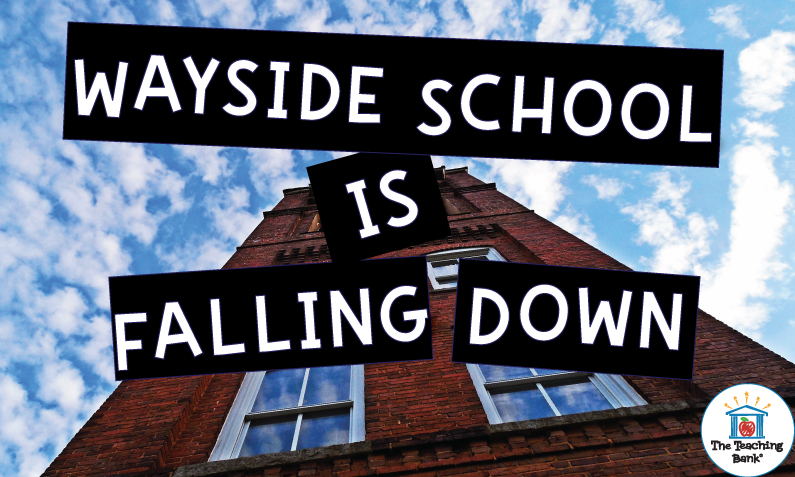
Looking for a funny, engaging novel that will keep your students reading while strengthening their ELA skills?Wayside School Is Falling Down by Louis Sachar is an excellent choice for an upper elementary novel study or book unit.
With its outrageous characters, unexpected plot twists, absurd situations, and clever humor, Wayside School Is Falling Down gives students plenty to laugh about—and plenty to think about.
But this quirky novel can do much more than entertain your students. It can also be a wonderful tool for teaching reading comprehension, vocabulary, critical thinking, creativity, writing, inference, and literary analysis.
We earn a commission if you make a purchase, at no additional cost to you.
Why Teach Wayside School Is Falling Down?
Published by Louis Sachar, Wayside School Is Falling Down takes readers back to the wonderfully strange Wayside School, where almost anything can happen.
The school was accidentally built 30 stories high with one classroom on each floor, and the students and teachers who inhabit it are just as unusual as the building itself.
From bizarre classroom situations to characters who don’t behave the way students expect, the novel constantly surprises readers.
That makes Wayside School Is Falling Down especially useful for classroom discussion.
Instead of simply asking students to remember what happened, you can encourage them to ask:
Why did that character behave that way?
What clues does the author give us?
What would you have done in that situation?
Is the situation meant to be taken literally?
Why is this scene funny?
What makes the characters memorable?
What can we learn from the characters’ choices?
Those conversations turn an entertaining children’s book into a rich ELA learning experience.
1. Build Reading Comprehension Skills
A Wayside School Is Falling Down novel study gives students numerous opportunities to practice important reading comprehension skills.
As students read, they can work on:
Making predictions: What do you think will happen next?
Making inferences: What can you figure out even though the author doesn’t directly tell you?
Making connections: How does a character’s experience connect to your own life or another text?
Analyzing characters: What do a character’s words, actions, and choices tell us about them?
Analyzing plot: How do individual events contribute to the overall story?
Evaluating the text: What do you think about a character’s decision or the author’s choice?
The unusual events in Wayside School Is Falling Down make these skills particularly engaging because students can’t always rely on conventional storytelling patterns.
2. Use Humor to Teach Deeper Thinking
One of the reasons students love Louis Sachar’s books is the humor.
But the humor in Wayside School Is Falling Down can also provide an excellent opportunity to teach students about how authors use language and unexpected situations to create humor.
The book frequently uses absurdity, exaggeration, irony, unexpected events, and unusual character behavior.
Ask students questions such as:
What makes this situation funny?
What did you expect to happen?
What actually happened?
Why is the difference between the two funny?
How does the author’s word choice contribute to the humor?
Would the scene be as funny if it happened in a realistic school?
These questions encourage students to move beyond simply saying, “That’s funny!” and begin thinking about why something is funny.
That’s an important reading skill—and a great way to introduce literary analysis in an accessible way.
3. Encourage Creativity and Imagination
Wayside School Is Falling Down is anything but ordinary.
A teacher can turn into an apple. A student can float away with balloons. A school can have classrooms stacked 30 stories high.
These wonderfully strange events give students permission to think creatively.
After reading a chapter, challenge students to imagine their own version of Wayside School.
What would happen if there were a 31st floor?
What would the strangest classroom in the school look like?
What unusual rule would the teacher have?
What completely unexpected event could happen during the school day?
These questions can easily become creative writing activities, narrative writing prompts, or classroom art projects.
The book gives students a model for thinking outside the box—and then invites them to create something of their own.
4. Develop Critical Thinking Skills
The absurd situations in Wayside School Is Falling Down also make excellent opportunities for critical thinking.
Students can examine characters’ decisions, question assumptions, consider alternative explanations, and defend their opinions with evidence from the text.
For example, students can discuss:
Was the character’s decision a good one? Why or why not?
What could the character have done differently?
What evidence supports your opinion?
How might another character view the same situation?
What assumptions did the characters make?
What would happen if one event in the story changed?
Because the novel doesn’t always behave the way students expect, it naturally encourages them to question, analyze, and reconsider.
5. Teach Vocabulary in Context
A novel study is also a natural way to build vocabulary.
Instead of teaching vocabulary words in isolation, students can encounter new words within the context of an engaging story.
With Wayside School Is Falling Down, students can:
Determine the meaning of unfamiliar words using context clues
Examine how word choice affects meaning
Use new vocabulary in their own writing
Practice spelling and word study
Discuss interesting or unusual language from the novel
Vocabulary instruction becomes much more meaningful when students encounter words while reading a story they actually want to understand.
6. Connect Reading to Writing
Wayside School Is Falling Down provides countless opportunities for writing.
Students can respond to the chapters, analyze characters, explain their thinking, make predictions, write creatively, or defend an opinion.
Some possible writing prompts include:
What would it be like to attend Wayside School?
Which character would you most want as your teacher? Explain why.
What would happen if Wayside School had a 31st floor?
Which event in the novel is the most surprising? Support your answer with evidence.
Choose a character and explain what you have learned about that character from their actions and choices.
These activities help students practice writing while keeping the writing connected to a book they are already reading.
A Complete Wayside School Is Falling Down Novel Study
If you want to teach Wayside School Is Falling Down but don’t want to spend hours creating comprehension questions, vocabulary activities, writing assignments, assessments, and lesson plans, I’ve done the work for you.
My Wayside School Is Falling Down Novel Study is a complete, no-prep novel unit for grades 3–5 designed to make teaching this hilarious Louis Sachar novel easier.
The resource includes 135+ pages of printable materials plus digital resources, giving you everything you need to turn the novel into a complete ELA unit.
What’s Included?
Teacher Materials
Daily lesson plans
Pacing and standards guide
Vocabulary word wall cards
Answer keys
Parent letter
Student Activities
Vocabulary activities
Chapter-by-chapter comprehension questions
Short-answer questions
Extension activities
Writing activities
Printable and digital resources
Assessments
Vocabulary quiz
Reading comprehension quiz
Short-answer assessment
Multiple-choice assessment
Writing assessment
Self-grading digital quizzes
Additional Literacy Activities
Story Elements interactive notebook activities
End-of-book activities
Additional writing activities
Activities that can be used with other novels
The unit is designed for 3rd-, 4th-, and 5th-grade classrooms and can be used for whole-class instruction, small-group reading, literature circles, independent work, or homeschool settings.
Make Your Wayside School Is Falling Down Unit Easy
Teaching a novel shouldn’t require you to spend your evenings searching for chapter questions, creating vocabulary worksheets, and putting together assessments.
A complete novel study gives you the structure and resources you need while allowing your students to focus on what matters most: reading, thinking, discussing, and enjoying the book.
And Wayside School Is Falling Down is an especially fun choice because students can laugh at the outrageous situations while simultaneously practicing important reading and thinking skills.
Try a free sample of the novel study for Wayside School is Falling Down
Ready to Start Your Wayside School Is Falling Down Novel Study?
If you’re planning a Louis Sachar novel study, upper elementary ELA unit, reading comprehension unit, or book study, this resource can save you valuable planning time.
Connect with Fellow Educators!
Are you teaching Wayside School is Falling Down this school year?
Join our free community, Book Talk with The Teaching Bank, to share ideas, grab freebies, and connect with 3rd–8th grade teachers using novels in the classroom!
The City of Ember is a fascinating book that really makes you wonder and think. It is suspenseful and engages the reader to want to continue. The City of Ember is the first book in DuPrau’s series, and it ends with the reader wanting more. It is a great book to hook your reluctant readers to continue the series on their own.
There are a lot of STEAM opportunities with this novel, and it will lead your students to examine what we may be doing to our Earth that may cause catastrophe down the line. It’s a thought-provoking novel to use in the classroom, in small groups, or in a homeschool setting.
We earn a commission if you make a purchase, at no additional cost to you.
Benefits of Using The City of Ember in Your Classroom:
Fosters Critical Thinking: The City of Ember invites readers into a dystopian world where critical thinking and problem-solving are essential for survival. Through the protagonists’ journey to unravel the mysteries of their underground city, students are prompted to analyze complex situations, make connections, and devise creative solutions. By engaging with the novel’s themes of resourcefulness and resilience, learners develop invaluable critical thinking skills that extend beyond the pages of the book.
Explores Societal Issues: DuPrau skillfully intertwines themes of sustainability, governance, and societal structures within the narrative of The City of Ember. From discussions on environmental responsibility to reflections on the consequences of authoritarianism, the novel provides a rich tapestry for exploring real-world issues in a thought-provoking manner. By examining these topics through the lens of fiction, students gain a deeper understanding of societal complexities and cultivate empathy for diverse perspectives.
Promotes Literacy and Language Skills: As educators, nurturing literacy skills is paramount, and The City of Ember offers a compelling vehicle for achieving this goal. Through immersive storytelling and vivid imagery, DuPrau captivates readers of all levels, making the novel accessible to a wide range of learners. By engaging with rich language and descriptive prose, students enhance their vocabulary, comprehension, and fluency, laying a solid foundation for academic success across disciplines.
Stimulates Cross-Curricular Connections: One of the greatest strengths of The City of Ember lies in its versatility across various subject areas. From science lessons on sustainability and environmental science to social studies explorations of governance and societal structures, the novel provides ample opportunities for interdisciplinary learning. By integrating discussions, projects, and activities inspired by the text, educators can foster holistic understanding and encourage students to make meaningful connections across academic domains.
Cultivates a Love for Reading: Beyond its educational merits, The City of Ember possesses a timeless allure that captivates readers of all ages. By immersing students in a compelling narrative filled with suspense, mystery, and adventure, educators have the power to ignite a lifelong passion for reading. Through guided discussions, independent exploration, and interactive experiences, teachers can cultivate an environment where literacy is celebrated and cherished as a gateway to new worlds and endless possibilities.
The City of Ember by Jeanne DuPrau stands as a shining example of the transformative power of literature in education. By embracing this captivating novel in the classroom, educators have the opportunity to foster critical thinking, explore societal issues, promote literacy skills, stimulate cross-curricular connections, and cultivate a love for reading that transcends the boundaries of the classroom.
I offer a complete novel study to accompany The City of Ember for use in the classroom or homeschool. The unit includes both a printable format and a Google Drive™ format for use in a paperless classroom or with Google Classroom. it is a great book to use in your classroom or homeschool for a whole class novel study, small book groups, or individual book studies.
Try a free sample of the novel study for The City of Ember
You can purchase this novel study at the following locations:
Are you interested in reading about and sharing ideas with other educators on using children’s literature in your classroom? My goal is to bring together teachers and homeschoolers who teach grades 3-8 and use novels with their students. I’d love for you to join me to learn, share, and grow together!
If you’re looking for a How to Eat Fried Worms novel study that will keep your students engaged while giving you meaningful reading comprehension, vocabulary, writing, and critical-thinking activities, How to Eat Fried Worms by Thomas Rockwell is a fantastic choice.
The humorous story of Billy and his friends immediately grabs students’ attention, but there’s much more to this classic children’s novel than its unforgettable title. How to Eat Fried Worms gives upper-elementary students opportunities to explore friendship, peer pressure, courage, decision-making, character development, and the consequences of our choices.
We earn a commission if you make a purchase, at no additional cost to you.
And for teachers, it’s a book that can turn into a rich ELA novel unit without requiring hours of preparation.
Why Teach How to Eat Fried Worms?
Some books are difficult to put down once students start reading them. How to Eat Fried Worms is one of those books.
The premise is simple: Billy accepts a bet that he can eat 15 worms in 15 days. What follows is a funny—and sometimes gross—adventure as Billy attempts to keep his promise while dealing with his friends, his fears, and increasingly creative ways of preparing worms.
That ridiculous-sounding premise is exactly what makes the novel so appealing to many upper-elementary readers.
But underneath the humor are some excellent opportunities for classroom discussion and literary analysis.
1. It Gets Reluctant Readers Interested in Reading
Getting students excited about a novel isn’t always easy.
A book about a boy who agrees to eat worms?
That gets their attention.
The humor and outrageous premise of How to Eat Fried Worms can be especially effective for students who aren’t naturally enthusiastic readers. Once students become invested in Billy’s challenge, they have a reason to keep reading to find out what happens next.
That makes this novel a great choice for:
4th grade ELA
5th grade ELA
6th grade ELA
Whole-class novel studies
Small-group reading
Literature circles
Independent reading
Homeschool reading
Reading intervention
2. Explore Friendship and Peer Pressure
One of the strongest themes in How to Eat Fried Worms is peer pressure.
Billy’s decision to accept the worm-eating challenge gives students an authentic way to discuss questions such as:
Why do people sometimes agree to things they don’t really want to do?
How does peer pressure influence our decisions?
What makes someone a good friend?
When should you stand up for yourself?
What are the consequences of making a decision just to prove something?
These questions can lead to meaningful classroom conversations that go far beyond simply asking students what happened in each chapter.
3. Build Reading Comprehension Skills
A strong novel study should do more than make sure students finished the assigned chapters.
How to Eat Fried Worms provides opportunities to practice important reading comprehension skills, including:
Identifying important details
Making inferences
Analyzing characters
Identifying problems and solutions
Determining cause and effect
Making predictions
Understanding themes
Summarizing
Supporting answers with evidence
Thinking critically about characters’ decisions
Using comprehension questions throughout the novel gives students a reason to slow down and think about what they’re reading rather than simply racing to the end of the book.
4. Teach Vocabulary in Context
The novel also provides opportunities to strengthen students’ vocabulary.
Rather than teaching vocabulary as a completely separate activity, students can encounter new words in the context of a story they actually want to read.
Students can practice:
Determining word meaning from context
Using new vocabulary correctly
Identifying synonyms and antonyms
Applying vocabulary in writing
Connecting words to the events and characters in the novel
This makes How to Eat Fried Worms vocabulary activities a natural part of the reading experience.
5. Connect Reading to Writing
A great novel study shouldn’t stop with comprehension questions.
Once students become invested in Billy’s challenge, the story provides plenty of writing opportunities.
Students can respond to characters, events, conflicts, and themes while practicing their ability to explain their thinking using evidence from the text.
Writing activities can help students move from:
“What happened?”
to:
“Why did it happen, and what do I think about it?”
That shift is an important part of developing stronger readers and writers.
A No-Prep How to Eat Fried Worms Novel Study
Of course, knowing that a book has great teaching potential is only half the battle.
The other question is:
How much time will it take to turn the novel into a complete unit?
Creating your own How to Eat Fried Worms worksheets, comprehension questions, vocabulary activities, writing assignments, assessments, and lesson plans can take hours.
Instead of piecing together activities from multiple sources, you can have your entire novel unit organized and ready to teach.
What’s Included in the How to Eat Fried Worms Novel Study?
The complete unit includes both printable and digital Google Drive™ resources, making it flexible enough for traditional classrooms, paperless classrooms, distance learning, small groups, and homeschool settings.
Teacher Resources
The teacher packet includes:
Detailed daily lesson plans
Pacing and Standards Guide
Chapter/Section Guide
Vocabulary Word Wall Cards
Answer keys
Parent letter
Student Activities
Students receive activities that include:
Vocabulary and grammar activities
Vocabulary practice for 36 words
Chapter-by-chapter comprehension questions
Short-answer questions designed to encourage deeper thinking
Extension activities connected to the novel
The extension activities are only included in the complete novel study, making the full unit a particularly valuable option if you want more than basic comprehension worksheets.
Assessments
The assessment packet includes:
After-the-book vocabulary quiz
After-the-book comprehension assessment
Multiple-choice comprehension questions
Short-answer comprehension questions
After-the-book writing assessment
Self-grading Google Drive™ multiple-choice quizzes
Additional Reading Activities
The unit also includes:
End-of-the-Book Activity Packet
Story Elements Interactive Notebook Activity Packet
Common Core Standards alignment for grades 4-6
Everything is designed to work together as a cohesive How to Eat Fried Worms book unit.
Printable or Digital? You Get Both.
Today’s classrooms don’t all look the same.
Some teachers still prefer students to work with printed pages. Others use Google Classroom and want digital resources. Many teachers use a combination of both.
That’s why this How to Eat Fried Worms novel study includes both printable and Google Drive™ formats.
You can print the materials for students who prefer paper or assign the digital version in your paperless classroom.
That flexibility also makes the unit useful for:
Classroom instruction
Google Classroom
Distance learning
Small-group instruction
Independent study
Homeschooling
Make How to Eat Fried Worms More Than Just a Book
The best novel studies help students experience a story while simultaneously developing stronger reading and thinking skills.
How to Eat Fried Worms gives you a particularly fun way to do that.
Students can laugh at Billy’s increasingly outrageous worm-eating challenge while also thinking about friendship, peer pressure, courage, decision-making, character traits, consequences, and personal responsibility.
And you don’t have to spend your weekend creating all of the materials yourself.
Download the FREE preview to see examples of the activities and lesson materials included in the unit.
It’s a great way to see how the novel study can fit into your classroom before you commit.
Ready to Teach How to Eat Fried Worms?
If you’re planning a 4th, 5th, or 6th grade novel study, this complete How to Eat Fried Worms book unit gives you the structure and resources you need to get started quickly.
No complicated preparation. No searching for individual worksheets. No piecing together vocabulary, comprehension, writing, and assessments from different resources.
Just grab your copy of How to Eat Fried Worms, download the unit, and start teaching.
Connect with Fellow Educators!
Are you teaching How to Eat Fried Worms this school year?
Join our free community, Book Talk with The Teaching Bank, to share ideas, grab freebies, and connect with 3rd–8th grade teachers using novels in the classroom!
*The Teaching Bank participates in the Amazon Associate Program and earns a fee from qualifying purchases made on the Amazon.com site.









 Connect with Fellow Educators!